
 manager@aeedenim.com
How to Start a Denim Brand with Custom Jeans: A Practical Guide for Startups

Launching a denim brand can feel harder than expected. You may already have a brand name, a moodboard and a clear idea of your target customer, but turning that vision into a real pair of jeans requires fabric decisions, fit development, sampling, pricing and production planning.
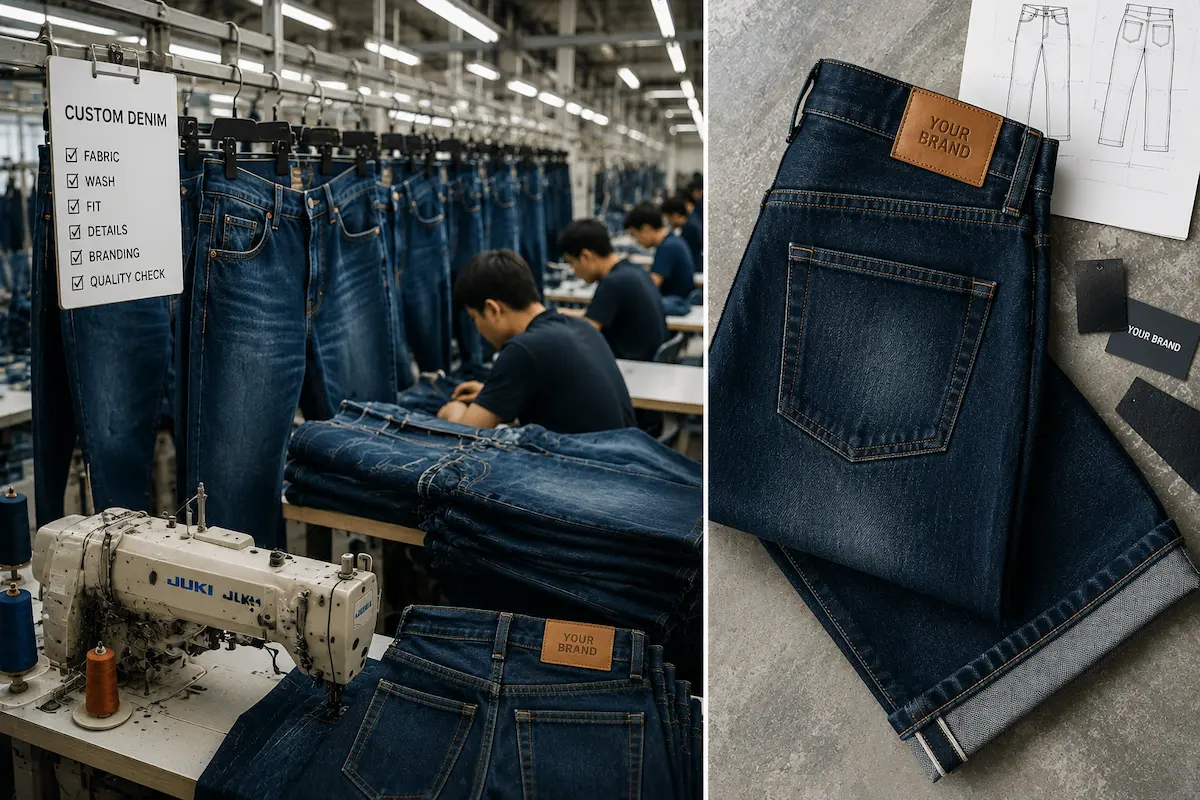
Generally, for fashion startups that want custom jeans, streetwear labels and independent designers, custom jeans can be a practical way to build a product that matches your brand identity from the first drop. Instead of accepting whatever stock styles are available, you can develop the fit, wash, trims and packaging around your target market.
However, custom production is not always the right first step for every startup. This guide explains how to decide between wholesale, private label and full custom jeans, what to prepare before contacting a manufacturer, and how to plan your first production run with realistic MOQ, budget and timeline expectations.
1. Why Custom Jeans Can Work for Startup Brands
In fact, custom jeans are useful for startups that want more control over product identity. Indeed, denim is a category where small details matter: fit, fabric weight, wash color, pocket placement, buttons, rivets, patches and labels all shape how the product feels to customers.
Custom production can help startups:
– Build a more distinct brand identity
– Develop a fit that matches the target customer
– Choose fabric and wash effects intentionally
– Add private label trims and packaging
– Test a focused first drop before scaling
– Avoid competing only on generic wholesale styles
For a new denim brand, the goal of the first order is not only to produce inventory. It is to validate whether your customer responds to your fit, wash, price point and brand presentation.
2. Wholesale, Private Label or Full Custom: Which Path Should You Choose?
However, not every startup needs full custom development from day one. The right sourcing model depends on your budget, timeline and product strategy.
| Sourcing Model | What It Means | Best For |
| Wholesale styles | Buying available or repeatable styles from a supplier | Fast market testing, boutiques and resellers |
| Light private label | Existing styles with your tags, labels or packaging | Early-stage brands that need branding with lower development risk |
| Full custom jeans | Developing your own fit, fabric, wash, trims and size specs | Brands building a differentiated denim collection |
Wholesale can be useful if you need speed, lower development effort or product variety. Full custom production is better when your fit, wash, branding and long-term product identity matter.
Many startup brands begin with available styles or light private label options, then move into full custom development once they understand which fits, washes and price points sell best.
3. When Custom Jeans May Not Be the Right First Step
On the other hand, custom jeans require time, sampling and development budget. They may not be the best first step if:
– Your budget is too limited for sampling
– You do not know your target customer yet
– You have no clear design references
– You need inventory immediately
– You only want to test whether denim sells in your store
– You cannot wait for sample development and bulk production
Therefore, wholesale denim styles or light private label options may be more practical. Once you validate demand, you can move toward custom jeans with clearer direction.
4. What “Custom Jeans” Actually Means for a Startup
In short, custom jeans do not always mean starting from a blank pattern. Many startup projects begin with a proven base fit or factory block, then adjust details to match the brand.
Specifically, custom options may include:
– Fit and silhouette
– Rise, inseam and leg opening
– Fabric weight and composition
– Stretch or rigid denim
– Wash effect
– Distressing or ripped details
– Embroidery, print or rhinestones
– Custom buttons and rivets
– Leather, PU or Jacron patches
– Woven labels and care labels
– Hang tags and packaging
For example, a startup may begin with a wide-leg jeans base, adjust the rise and inseam, choose a vintage wash, then add branded buttons, a leather patch and custom packaging.
This approach keeps development more realistic while still creating a product that feels specific to your brand.
If you want more on branding details, see our private label denim guide.
5. What to Prepare Before Contacting a Manufacturer
Above all, the quality of your first conversation with a manufacturer depends on how clearly you describe your project. You do not need a perfect tech pack to start, but you should prepare enough information for the factory to evaluate feasibility, MOQ, sample cost and timeline.
Before contacting a custom jeans manufacturer, prepare:
– Front and back reference photos
– Fit direction, such as straight, baggy, flare or skinny
– Men’s, women’s or unisex category
– Fabric preference, such as rigid, stretch or heavyweight denim
– Wash reference and target color
– Size range
– Target quantity
– Branding needs
– Packaging requirements
– Target retail or wholesale price if available
– Shipping destination
– Expected launch date
If you already have an existing sample, size chart or tech pack, include it. If not, clear reference photos and written notes are enough to begin a development discussion.
6. Tech Pack Basics for First-Time Denim Founders
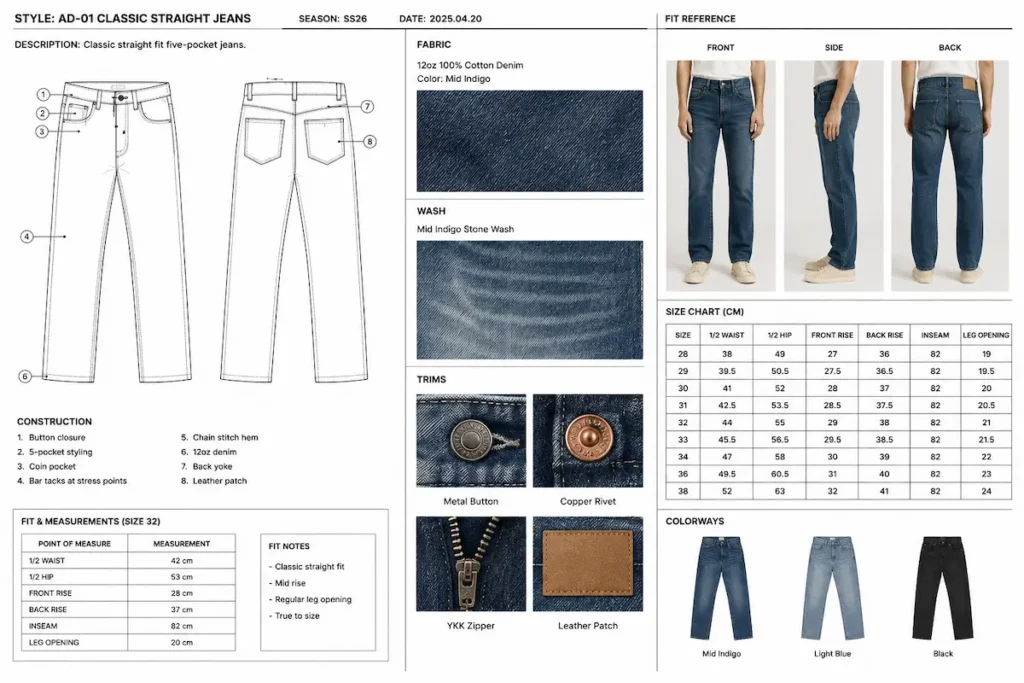
In addition, a tech pack is a document that explains how your jeans should be made. It helps reduce guessing and makes the quotation, sampling and production process more accurate.
For instance, a basic jeans tech pack may include:
– Front and back flat sketches
– Measurement points
– Base size measurements
– Full size range if available
– Fabric weight and composition
– Stretch percentage
– Wash reference
– Stitching details
– Pocket placement
– Button and rivet details
– Patch and label placement
– Packaging requirements
– Tolerance table
– Fit comments
For first-time founders, the tech pack can be developed gradually during sampling. The important thing is to start with clear references and update the document as each detail is confirmed.
If you want a deeper explanation of fit and size development, see our fit and grading guide.
7. MOQ, Budget and Timeline Expectations
First, MOQ is one of the first questions most startup founders ask. The answer depends on fabric, wash, trims, size range and production schedule.
For instance, many startup denim projects may start from around 50 to 100 pieces per style. For a deeper look at low-minimum sourcing, see our low MOQ jeans manufacturer guide. For selected stock fabrics and simpler designs, lower starting quantities may be possible depending on project details. By contrast, more complex washes, special fabric, custom hardware or packaging may require higher minimums.
Cost also depends on:
– Fabric type
– Wash complexity
– Pattern development
– Sampling rounds
– Trims and branding
– Packaging
– Order quantity
– Shipping method
Your first order may have a higher unit cost than repeat orders because setup and development costs are spread across fewer pieces. In summary, this is normal for low MOQ custom production.
For a full cost breakdown, see our custom jeans pricing guide.
8. Sampling Process: From Prototype to PP Sample
Next, sampling is where your denim idea becomes a physical product. This stage should not be rushed because it controls fit, wash, construction and final bulk quality.
A typical startup sampling process may include:
(1) Prototype Sample
The prototype checks the base fit, silhouette and construction. It may not use final trims or final wash.
(2) Fit Sample
The fit sample corrects measurements, rise, thigh width, leg opening and overall wearing comfort. If needed, it can be tested on a live model or compared with a reference sample.
(3) Wash Sample
The wash sample confirms color, hand feel, fading, distressing and shrinkage. This is important because denim changes significantly after washing.
(4) Pre-Production Sample
The pre-production sample, often called a PP sample, should represent the final approved product. It should include confirmed fabric, wash, trims, labels and construction details.
Bulk production should not begin until the PP sample is approved.
9. Planning Your First Production Run
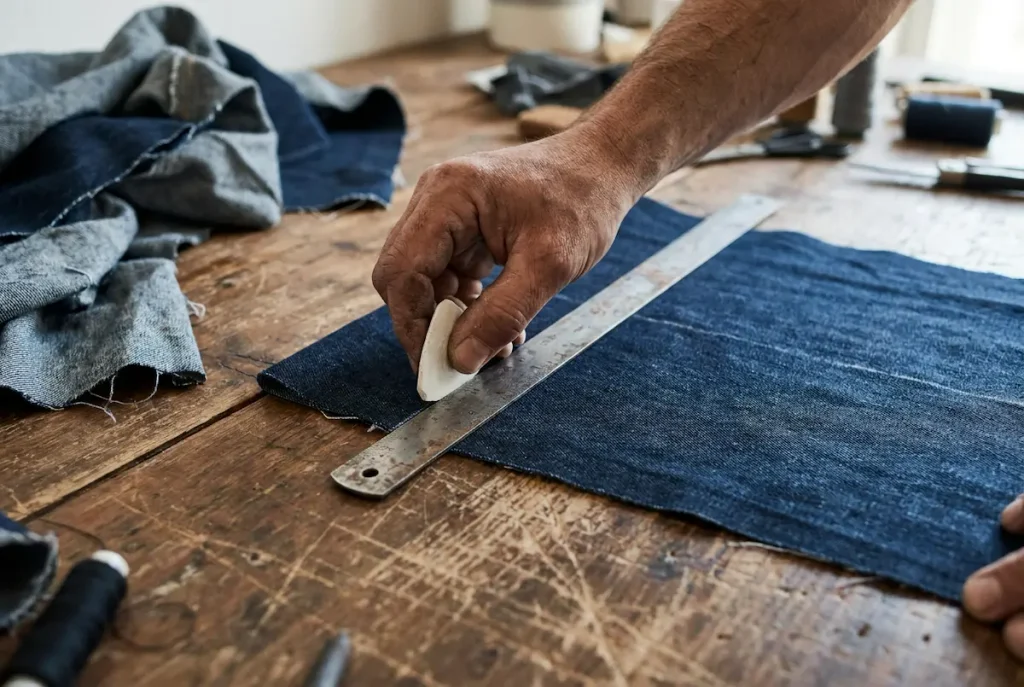
After sample approval, the first production run begins. This stage usually includes fabric sourcing, cutting, sewing, washing, finishing, quality inspection and packing.
For many startup projects, first bulk production may take around 30 to 45 days after sample approval, depending on fabric availability, wash complexity, order quantity and production schedule.
Before production starts, confirm:
– Final sample approval
– Quantity per size
– Size ratio
– Fabric and wash
– Button, rivet and zipper details
– Labels and packaging
– Shipping terms
– Delivery timeline
– Quality inspection standard
For first-time brands, it is better to start with a focused quantity and limited size range than to spread budget across too many fits, colors and sizes.
10. Common Mistakes That Delay Startup Denim Projects
In fact, most delayed or failed startup denim projects come from avoidable planning issues.
Common mistakes include:
– Skipping samples to save time
– Changing design details after PP sample approval
– Starting without clear reference photos
– Choosing fabric only by price
– Underestimating shipping and import costs
– Ordering too many sizes before testing demand
– Using complex trims before confirming budget
– Approving a wash without physical sample review
– Asking for a quote without quantity or fabric details
Overall, the best startup denim projects treat the first order as a controlled launch. The goal is to test market response, collect feedback and build a repeatable product foundation.
11. How Aeedenim Supports Startup Denim Brands
Finally, Aeedenim works with fashion startups, streetwear labels, independent designers and private label brands that want to develop custom denim products.
For startup denim projects, we can support:
– Custom jeans, denim jackets, shorts, skirts and denim sets
– Available style review and custom development planning
– Fabric and wash recommendations
– Fit and sample development
– Low MOQ options depending on fabric and design requirements
– Private label trims and packaging
– Distressing, embroidery, print or rhinestone options
– Production planning after sample approval
– Export packaging and shipping coordination
Our team can help review your reference photos, target quantity, size range, wash idea and branding requirements before sampling.
12. FAQ
(1) What is the minimum order quantity for a startup denim brand?
In short, MOQ depends on fabric, wash, trims and design complexity. Many startup denim projects may start from around 50 to 100 pieces per style, while selected stock fabrics and simpler designs may allow lower starting quantities.
(2) How much does it cost to develop custom jeans?
The total cost depends on fabric, wash, trims, sampling rounds, order quantity and packaging. Most startups should budget for sample development first, then compare the per-unit cost for different order quantities.
(3) How long does a first production run take?
After sample approval, a first production run may take around 30 to 45 days depending on fabric availability, wash complexity, trims and production schedule. Sampling time should be planned separately before bulk production.
(4) Do I need a finished tech pack to start?
No. A finished tech pack is helpful, but not always required at the beginning. You can start with reference photos, design notes, target measurements, fabric preference and branding ideas.
(5) Can I use my own labels, buttons and packaging?
In particular, custom labels, buttons, patches, hang tags and packaging are common private label options for custom denim projects. Some trims may have their own MOQ and lead time.
(6) Should a startup choose wholesale or custom jeans first?
In contrast, wholesale may be better for fast market testing or immediate inventory. Custom jeans are better when your brand needs a unique fit, wash, trim package and long-term product identity.
(7) What should I send to Aeedenim for a project review?
Above all, send your reference photos, target quantity, size range, fabric preference, wash idea, branding requirements, shipping destination and expected launch timeline. If you have a tech pack or physical sample, include it as well.
Start Your Denim Brand with Custom Jeans.
Planning your first denim drop does not need to start with a large inventory risk. With the right development process, startup brands can test custom jeans with realistic MOQ, clear samples and private label details.
Contact Aeedenim to discuss your custom jeans project, target quantity, fabric, wash and branding requirements. Our team can help evaluate whether wholesale styles, low MOQ customization or full custom development is the right path for your first production run.