
 manager@aeedenim.com
Denim Branding Essentials: Custom Buttons, Rivets, Patches and Packaging

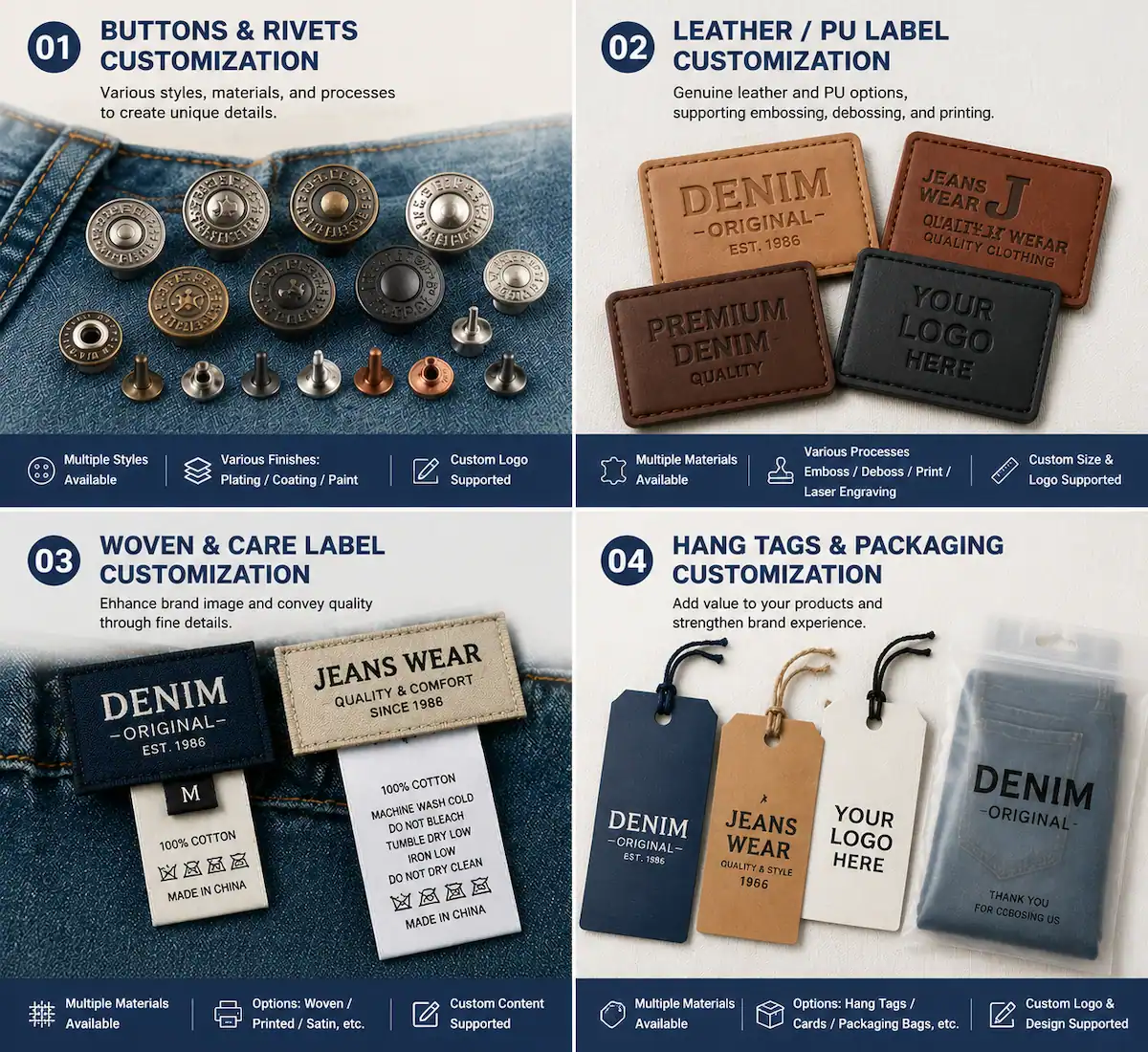
A great denim product is defined not only by its fabric, fit and wash, but also by the details that carry your brand identity. For fashion startups, streetwear labels, independent designers and private label collections, custom branding elements can turn standard jeans into recognizable products that customers remember.
From shank buttons and rivets to leather patches, woven labels, hang tags and packaging, every trim contributes to the overall perception of quality. When these details are consistent, your denim collection feels more professional and more complete.
As a custom denim manufacturer, Aeedenim helps brands develop private label denim products with coordinated trims, labels and packaging based on their design direction and order requirements.
1. Why Denim Branding Matters for Small and Growing Brands
For many small brands, the product itself is the main brand experience. Customers may first discover your jeans online, receive them through shipping and judge the brand by the details they can see and touch.
Custom branding on jeans and jackets can help with:
– Differentiation: Custom hardware and labels separate your product from generic wholesale jeans.
– Perceived value: Branded trims and packaging can make the product feel more professional.
– Customer trust: Consistent details show that the brand has planned the product carefully.
– Repeat recognition: Customers are more likely to remember a product with clear brand identity.
– Social content: Branded details are easier to show in product photos, lookbooks and social media content.
Branding does not always need to be complex. Even a simple custom button, woven label and leather patch can make a small denim collection feel more complete.
2. Custom Buttons and Shank Buttons
Buttons are one of the most visible branding elements on jeans and denim jackets. They appear on the waistband, fly, cuffs, chest pockets and jacket front placket.
For jeans, the main shank button at the center front is especially important because it is used every time the garment is worn.
(1) Common Button Materials and Finishes
| Material / Finish | Appearance | Best For |
| Copper | Warm reddish tone, vintage feeling | Heritage, workwear and washed denim |
| Brass | Gold-toned classic finish | Premium denim and classic jeans |
| Silver / Nickel | Clean metallic appearance | Minimalist and contemporary fashion |
| Gunmetal | Dark grey industrial look | Streetwear, utility and urban styles |
| Antique finishes | Aged brass or copper with darker details | Vintage, distressed and heritage styles |
(2) Button Customization Options
Custom buttons can include:
– Logo engraving
– Brand name text around the rim
– Embossed or debossed details
– Custom diameter and thickness
– Custom shape
– Matching rivet sets
– Antique or polished finish
Most custom button projects require a mold fee and a separate MOQ. For many projects, custom buttons may start from around 500-1000 pieces per design, depending on supplier requirements and design complexity.
Aeedenim can help brands confirm button size, material, finish and logo artwork before ordering custom hardware.
3. Rivets: Small Details with Functional Value
Rivets are small, but they play an important role in denim construction. They reinforce pocket corners and stress points while also adding visual detail.
For private label denim, rivets can be matched with buttons to create a consistent hardware system.
(1) Common Rivet Types
| Rivet Type | Description | Best Use |
| Flat head rivets | Smooth and minimal surface | Clean, modern denim styles |
| Domed rivets | Raised rounded surface | Classic jeans and vintage styles |
| Custom embossed rivets | Logo or pattern pressed into the metal | Stronger brand identity |
| Burr rivets | Traditional two-part construction | Heritage and workwear-inspired denim |
(2) Rivet Customization Options
Brands can customize:
– Metal color
– Surface finish
– Logo detail
– Rivet size
– Back style
– Matching button and zipper finish
When developing rivets, it is important to consider both appearance and function. The rivet should match the fabric weight and garment construction, especially for heavyweight denim or workwear-inspired styles.
4. Leather Patches, PU Patches and Jacron Patches
A back waistband patch is one of the most recognizable details on a pair of jeans. It can carry your logo, brand name, size information or collection message.
Different patch materials create different brand impressions.
(1) Common Patch Materials
| Patch Material | Features | Best For |
| Genuine leather | Natural grain, ages with wear, premium feeling | Heritage, premium and workwear denim |
| PU leather / vegan leather | Consistent finish, animal-free, cost-effective | Streetwear and fashion brands |
| Jacron paper patch | Paper-like texture, lightweight and eco-conscious | Sustainable or minimalist denim |
| Fabric patch | Softer hand feel, flexible design options | Casualwear and creative branding |
(2) Patch Customization Options
Custom patches can include:
– Debossed logo
– Embossed logo
– Foil stamping
– Screen printing
– Laser engraving
– Custom shape
– Size or fit information
– Collection name or slogan
Leather patches and PU patches usually have their own MOQ separate from garment MOQ. For many projects, patch MOQ may start from around 300-500 pieces per design, depending on material, size and production method.
For smaller test orders, brands may also consider simpler patch designs or stock material options to reduce development cost.
5. Woven Labels and Care Labels
Labels serve both branding and product information purposes. A complete private label denim product usually includes visible brand labels and internal care labels.
(1) Main Brand Labels
Main labels are often placed inside the waistband, inside the jacket neck area or inside the garment back seam.
Common label types include:
– Woven damask labels: Fine detail, soft hand feel and premium appearance
– Satin labels: Smooth and glossy, suitable for fashion branding
– Taffeta labels: Durable and cost-effective for bulk production
– Printed labels: Good for complex multi-color artwork
(2) Placement Options
Labels can be placed in:
– Inside back waistband
– Inside front pocket bag
– Side seam
– Jacket neck area
– External patch position
– Hem or cuff area
(3) Care Labels
Care labels usually include important product information such as:
– Fabric composition
– Country of origin
– Washing instructions
– Size information
– Brand or manufacturer details where required
Care label requirements vary by market. Brands should confirm fiber composition, origin and care instruction requirements before production. Aeedenim can help organize care label information based on the details provided by the brand and the target market.
6. Hang Tags and Packaging
Hang tags and packaging are part of the customer’s first impression. They are especially important for direct-to-consumer brands, boutique labels and premium denim collections.
(1) Hang Tag Options
Hang tags can be simple or highly customized, depending on your budget and brand direction.
Common options include:
– Kraft paper hang tags
– Coated cardstock hang tags
– Double-sided printed tags
– Custom die-cut shapes
– Logo-shaped tags
– Cotton string, twine or safety pin attachments
– QR code for brand story or care instructions
Hang tags can include your logo, collection name, size, fabric details, care information or brand story.
(2) Packaging Options
Packaging options may include:
– Individual poly bags
– Printed poly bags
– Tissue paper wrapping
– Custom sticker seals
– Branded shipping boxes
– Recyclable or biodegradable packaging options
– Barcode labels for inventory managementFor small brands, packaging should balance brand presentation and cost. A simple branded sticker, hang tag and clean bag may be enough for early collections.
7. How to Coordinate Branding Across All Trims
The most professional denim brands keep their branding consistent across all trims. This does not mean every detail needs to be expensive. It means every detail should feel like it belongs to the same brand.
Before ordering custom trims, check whether these elements match:
– Button and rivet metal finish
– Zipper and hardware color
– Leather patch or PU patch color
– Woven label colors
– Hang tag paper and print style
– Packaging color and logo placement
– Font and logo size
– Overall brand mood
For example, a vintage workwear brand may choose antique brass buttons, copper rivets and a genuine leather patch. A clean streetwear brand may choose matte black hardware, a PU patch and minimal woven labels.
8. What to Prepare Before Developing Custom Denim Branding
A clear branding file can make trim development faster and more accurate. Before contacting a manufacturer, prepare as much of the following as possible:
– Logo file in AI, EPS, SVG or high-resolution PDF format
– Black-and-white logo version for engraving or embossing
– Pantone color codes if available
– Preferred metal finish
– Patch material preference
– Button and rivet reference images
– Label wording
– Care label information
– Hang tag design or reference
– Packaging reference
– Target order quantity
– Target market
– Budget range for trims and packaging
If you do not have complete files yet, a manufacturer can still help you review reference images and suggest practical options for sampling.
9. MOQ and Lead Time for Custom Trims
Custom trims often require separate production time from garment production. This means buttons, patches, labels and packaging should be confirmed early in the development process.
| Trim Type | Typical MOQ | Typical Lead Time |
| Custom buttons | 500-1000 pcs | 15-25 days |
| Custom rivets | 500-1000 pcs | 15-25 days |
| Leather / PU patches | 300-500 pc | 10-20 days |
| Woven labels | 500-1000 pcs | 10-15 days |
| Hang tags | 500-1000 pcs | 7-10 days |
| Custom packaging | 500-1000 pcs | 10-20 days |
Actual MOQ and lead time may vary depending on material, design complexity, supplier availability and artwork requirements.
Aeedenim coordinates trim sourcing alongside garment production so that branding elements can be prepared before bulk assembly begins.
10. How Aeedenim Supports Private Label Denim Branding
Aeedenim supports fashion startups, streetwear brands, independent designers and private labels with custom denim manufacturing and private label development.
For branding and trim development, we can help with:
– Custom button development
– Rivet and hardware matching
– Leather, PU and Jacron patch options
– Woven label and care label production
– Hang tag and packaging coordination
– Trim color and material matching
– Brand guideline review
– MOQ guidance for different trim types
– Sample confirmation before bulk trim production
– Low MOQ garment production depending on design and fabric requirements
Our team helps brands connect fabric, fit, wash, trims and packaging into one complete denim product.
11. FAQ
(1) What is the MOQ for custom buttons?
Custom buttons often start from around 500-1000 pieces per design, depending on the supplier, material and mold requirements. The same button design can sometimes be reused across jeans, jackets and future collections.
(2) Can I customize leather patches for small denim orders?
Yes. Leather, PU or Jacron patches can be customized for private label denim projects. Patch MOQ may start from around 300-500 pieces, depending on material and design. For very small test orders, simpler patch designs or stock material options may help reduce cost.
(3) How long do custom trims take to produce?
Lead time depends on the trim type. Buttons and rivets may take around 15-25 days, woven labels around 10-15 days, and patches around 10-20 days. Final timing depends on artwork confirmation and supplier availability.
(4) What artwork format do I need for custom branding?
Vector files such as AI, EPS or SVG are preferred. High-resolution PDF files may also work for some items. For engraving, embossing or woven labels, a clean black-and-white logo version is useful.
(5) Can I use the same button design for jeans and denim jackets?
Yes. Reusing the same button, rivet or label design across multiple garment styles can help reduce trim cost and keep your branding consistent.
(6) Do I need different care labels for different markets?
Care label requirements vary by market. Brands should confirm fiber composition, origin and care instruction requirements before production. If you sell in different markets, label content may need to be adjusted.
(7) Can custom packaging be developed for low MOQ denim orders?
Yes, but packaging MOQ may be separate from garment MOQ. For early-stage brands, simple branded options such as hang tags, stickers and clean poly bags may be more practical than fully customized boxes.
Choosing the right factory is as important as choosing the right trims. Read our guide on how to choose a reliable custom jeans manufacturer in China to evaluate production partners.
A consistent brand identity should flow through your entire collection, including outerwear. Our custom hardware, from engraved shank buttons to premium leather patches, is perfectly calibrated for heavy-duty denim. You can explore how these branding elements are integrated into our custom denim jackets to see the professional finish we can achieve for your brand’s next outerwear drop.
Start Your Private Label Denim Project
Ready to build a more professional denim collection with custom buttons, patches, labels and packaging?
Contact Aeedenim to discuss your private label denim project. Our team can help you plan branding elements, confirm MOQ and lead times, and start sample development for your custom jeans, jackets or denim collection.