
 manager@aeedenim.com
How to Source Distressed and Ripped Jeans from a Trusted Supplier: Washing Techniques, QC and Sourcing Guide

Distressed and ripped jeans may look effortless, but every torn knee, faded whisker and worn hem comes from a controlled denim development process.
For US, UK and European brands, however, the real challenge is not only finding a supplier that can make ripped jeans. In other words, the challenge is finding a distressed ripped jeans supplier who can repeat the approved effect from sample to bulk production.
In short, a good distressed denim project requires the right fabric, wash process, distress method, sample approval and quality control standard. This guide explains the main washing and distressing methods, how to specify them in your tech pack and what to check before placing a bulk order.
1. Why Distressed Denim Requires More Process Control
Distressed denim often sells at a higher perceived value because it looks more developed than a clean-wash jean. However, it also carries higher production risk.
For example, a distressed jean may go through multiple steps, including base washing, whiskering, sanding, grinding, ripping, fraying, softening and final inspection. Moreover, each step affects the final appearance and durability.
Common risks include:
– Rips becoming larger than intended
– Fraying loosening after washing
– Whisker patterns looking different from the approved sample
– Abrasion appearing in the wrong position
– Color inconsistency between sample and bulk
– Fabric tearing too easily during wear
– Higher defect rate during bulk production
For this reason, distressed denim should be developed with clear reference photos, a defined distress level and sample-to-bulk control.
2. Core Denim Washing Techniques for Distressed Jeans
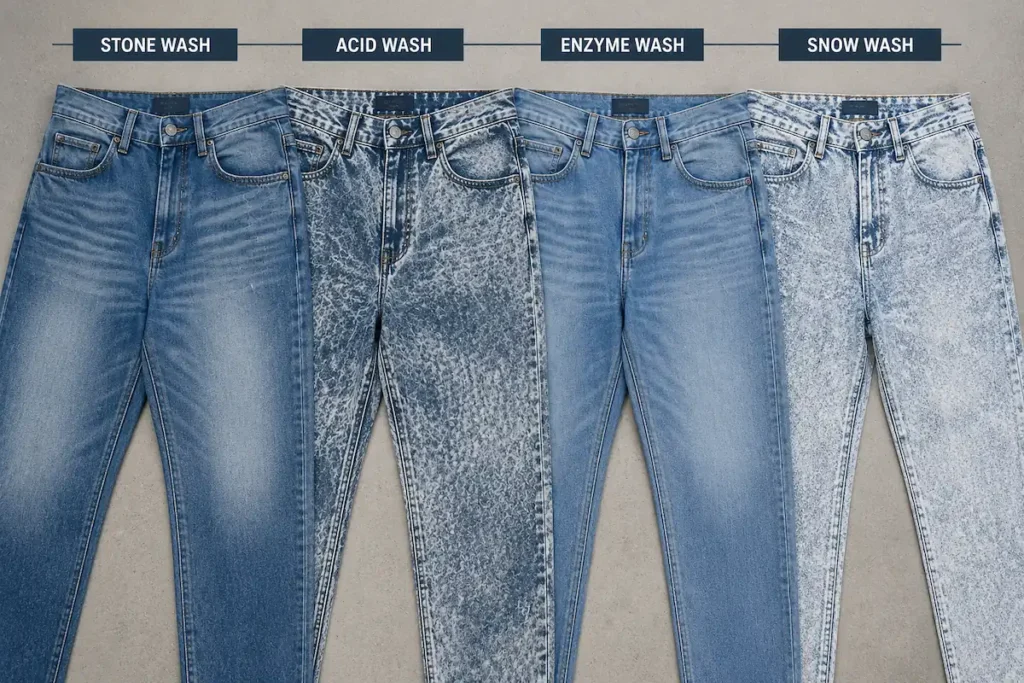
First, most distressed jeans begin with a base wash.
The wash changes fabric color, hand feel and surface texture before additional ripping or distressing is applied.
| Washing Technique | Effect | Typical Application |
| Stone wash | Softens fabric and creates abrasion contrast | Casual and vintage denim looks |
| Enzyme wash | Removes surface indigo with a softer hand feel | Everyday fading and lower-impact washing |
| Acid wash | Creates high-contrast, cloudy or marbled effects | Retro, Y2K and streetwear styles |
| Snow wash | Produces strong mottled or frost-like effects | Statement denim pieces |
| Rinse / dark wash | Minimal color loss and cleaner finish | Premium raw-inspired jeans |
| Bleach wash | Lightens denim color significantly | Light blue, washed-out or high-contrast effects |
| Laser effect | Creates controlled fading or patterns | Repeatable whiskers, logos or distress marks |
However, washing alone does not create rips, frayed holes or destroyed effects. As a rule, those details usually require a second stage of physical or laser distressing. For a deeper look at each washing technique and how to choose the right wash for your collection, see our denim washing techniques guide.
3. How Ripped, Whiskered and Destroyed Effects Are Made
After the base wash is confirmed, the factory creates distressing through different methods.
(1) Whiskering
For example, whiskering refers to fine horizontal fading around the crotch, thigh or knee area. In addition, it can be created by hand or with laser technology.
However, good whiskering should look natural and match the jean’s fit. If the whiskers are placed too high, too low or too evenly, the jeans can look artificial.
(2) Hand Sanding and Grinding
For example, hand sanding and grinding create targeted abrasion on the thighs, knees, hems or pocket edges. Typically, these methods are often used for vintage, streetwear and premium distressed denim.
Because these steps involve manual work, slight variation between garments is normal. The factory should still maintain an approved standard for placement and intensity.
(3) Ripping and Fraying
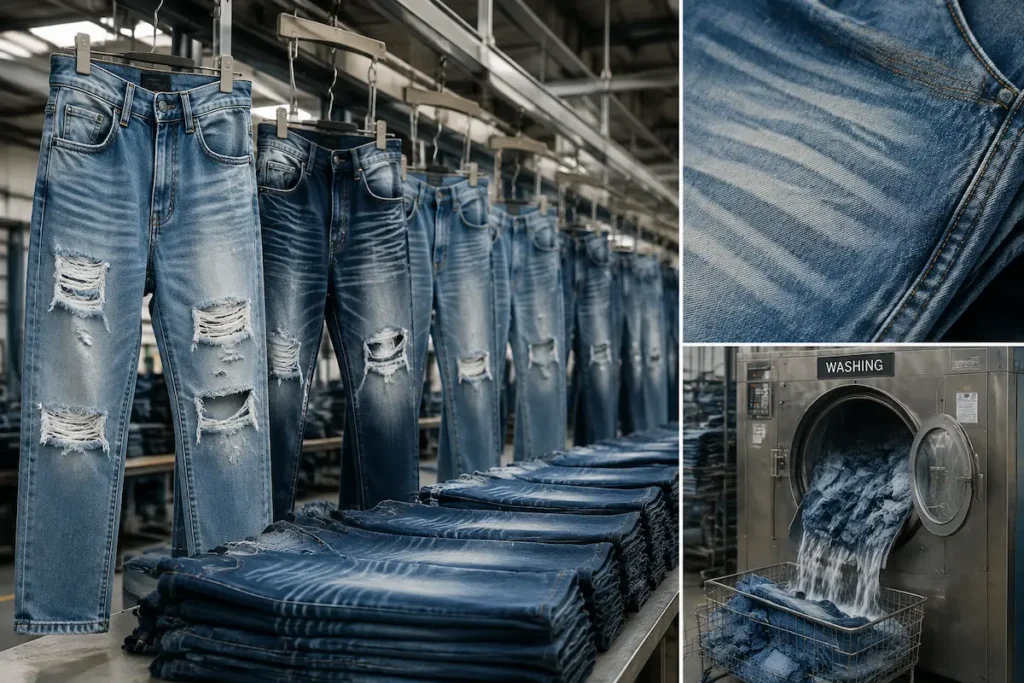
Next, ripping and fraying create cuts, tears and exposed threads. Meanwhile, the factory may open the fabric by hand and control how much of the warp or weft thread remains visible.
Important points include:
– Rip position
– Rip size
– Fray length
– Reinforcement if needed
– Durability after washing
– Consistency across sizes
(4) Laser Distressing
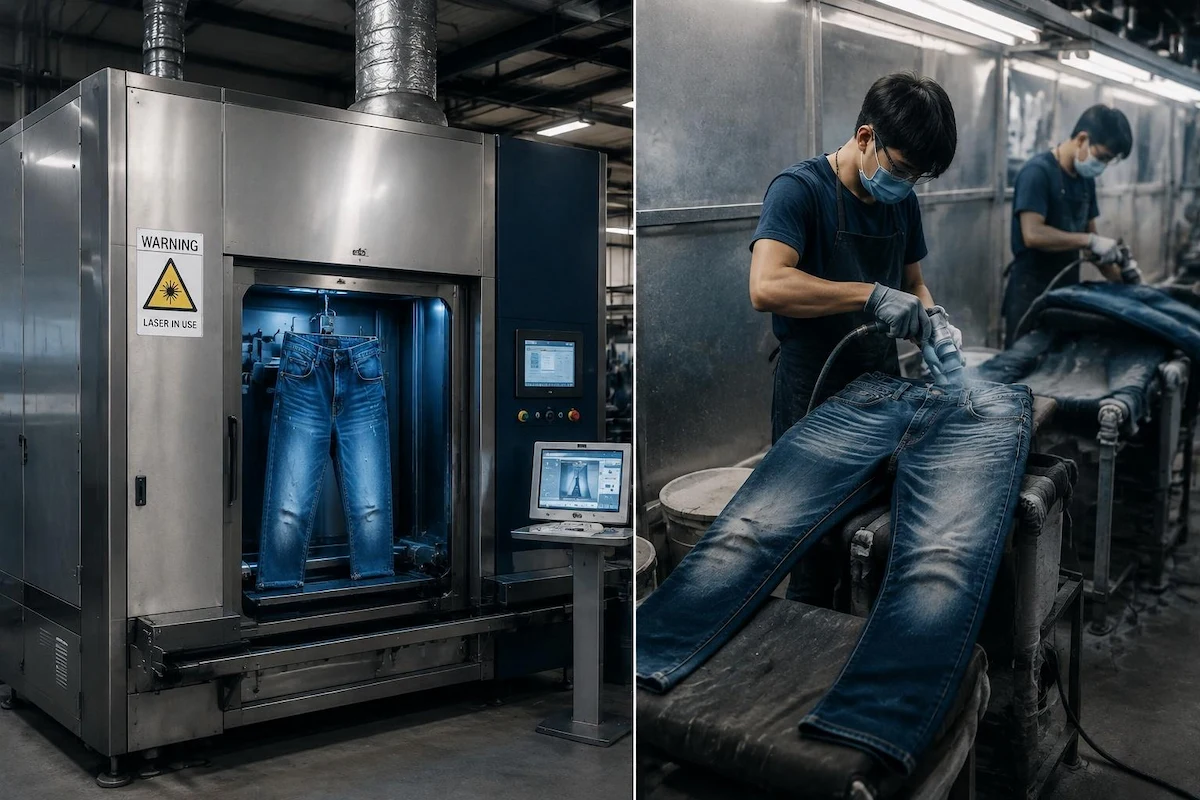
Finally, laser distressing uses controlled laser patterns to create fading, whiskers, logo effects or worn areas. In particular, it is useful when the design requires repeatability across larger quantities.
In short, many brands combine laser distressing with hand finishing to balance consistency and natural appearance.
4. Laser Distressing vs Sandblasting and Hand Finishing
Sandblasting was once used to create fast distressed effects, but it has been restricted or banned in many markets and by many major brands because of worker safety risks related to silica dust.
Instead, for US, UK and EU buyers, suppliers should be able to explain safer alternatives, such as:
– Laser distressing
– Hand sanding
– Enzyme washing
– Grinding
– Controlled abrasion
– Wash testing before bulk production
Moreover, laser distressing is generally more consistent and easier to repeat. In contrast, hand finishing creates a more organic look but requires experienced workers and clear inspection standards.
Ultimately, a responsible supplier should be able to explain which method is best for your design, quantity, fabric and target price.
However, for import planning and labeling considerations, see our guide to importing custom jeans into the US and Europe.
5. Hand-Made vs. Machine-Made Distressing
In fact, both hand-made and machine-made distressing can be useful depending on the project.
| Method | Strength | Limitation | Best For |
| Hand distressing | Natural, premium and flexible | Higher labor cost and more variation | Designer styles, small batches and premium denim |
| Laser distressing | Consistent, repeatable and faster | Less organic without hand finishing | Larger runs and repeatable patterns |
| Grinding tools | Strong abrasion and edge wear | Needs careful control | Knees, hems and pocket edges |
| Wash-only fading | Softer and more subtle | Cannot create true rips | Vintage everyday denim |
For many custom distressed jeans, the best production plan combines methods. For example, laser may create the base whisker pattern, while hand sanding adds final depth and natural variation.
6. How to Specify Distress Level in Your Tech Pack
In practice, one of the biggest causes of sample and bulk-order failure is vague wording. If a buyer only writes “distressed jeans,” the factory may interpret the design differently.
To start, use a simple distress level system to define the intended look.
| Distress Level | Description |
| Level 1 | Light whiskering and minor abrasion only |
| Level 2 | Visible fading with small sanding marks |
| Level 3 | Whiskering plus knee or thigh rips with light fraying |
| Level 4 | Multiple rips, heavy abrasion and visible fraying |
| Level 5 | Heavy destroyed finish with large tears and exposed threads |
Specifically, in your tech pack or design brief, include:
– Front and back reference photos
– Flat sketch with rip positions marked
– Distress level
– Wash reference
– Fabric weight and composition
– Whether rips should be reinforced
– Maximum rip size
– Fray length reference
– Size range
– Target quantity
– Whether laser, hand distressing or mixed methods are preferred
As a result, the more specific your instructions are, the easier it is for the supplier to develop an accurate sample.
7. Quality Checks for Distressed and Ripped Jeans
Additionally, distressed denim needs stricter inspection than clean-wash jeans because the damage is part of the design.
Specifically, before accepting bulk goods, check:
– Rip position compared with approved sample
– Rip size and fray length
– Whether rips tear further after washing
– Whisker placement and intensity
– Abrasion consistency across pieces
– Color consistency between panels
– Fabric strength around damaged areas
– Hardware and stitching after washing
– Measurements after wash
– Packing protection for heavily distressed styles
Ask the factory to test finished garments when possible, not only fabric swatches. This matters because rips and frayed areas behave differently after full garment washing, drying and handling.
Finally, for large orders, define an acceptable tolerance for distress placement and intensity before production begins.
8. How to Evaluate a Distressed Ripped Jeans Supplier
Above all, a capable distressed jeans supplier should be able to explain the production process clearly.
(1) Key questions to ask:
– What base wash do you recommend for this style?
– Will the distressing be done before or after washing?
– Can you make a sample based on my reference photo?
– Do you use laser, hand sanding, grinding or mixed methods?
– How do you control rip placement across sizes?
– Can you provide past wash or distress samples?
– How do you inspect fraying and durability?
– What is the MOQ for this distress level?
– Will complex distressing affect lead time or cost?
(2) Warning signs include:
– No wash sample library
– No clear explanation of the distress sequence
– No reference standard for rip placement
– No sample-to-bulk tolerance discussion
– Refusing to provide physical samples before bulk
– Only saying “we can do it” without process details
– Unclear MOQ or lead time
– No inspection process for rips, fraying or wash consistency
For a broader sourcing checklist, see our wholesale jeans supplier guide.
9. MOQ, Cost and Lead Time for Distressed Denim
In general, distressed denim usually costs more than clean-wash jeans because it involves extra labor, process control and inspection.
Cost may increase because of:
– Hand sanding
– Grinding
– Ripping
– Fraying
– Laser setup
– Additional wash tests
– Higher defect risk
– More inspection time
In many projects, distressed styles may cost around 10-25% more than a clean-wash equivalent, but the actual difference depends on fabric, wash complexity, distress level, order quantity and quality requirements.
Furthermore, MOQ depends on complexity. At the same time, many custom distressed jeans projects may start from around 50 to 100 pieces per style, but complex hand-distressed styles may require higher minimums or longer lead time.
For lower starting quantities, review our low MOQ jeans manufacturer guide. For a broader pricing explanation, see our custom jeans pricing guide.
10. How Aeedenim Supports Custom Distressed Jeans
For brands at any scale, Aeedenim works with streetwear brands, fashion startups, independent designers and private labels to develop custom denim products, including distressed jeans, ripped jeans, washed denim jackets, shorts and denim sets.
For custom distressed denim projects, we can support:
– Wash reference review
– Fabric selection for distressed effects
– Enzyme, stone, acid, snow, rinse, bleach and laser wash options
– Hand sanding, grinding and ripped detail development
– Sample development before bulk production
– Distress level confirmation
– Private label trims and packaging
– Flexible MOQ depending on fabric, wash and design requirements
– Quality checks for wash consistency, measurements and distress placement
Finally, our team can help review your reference photos, target quantity, fabric preference and distress level before sampling.
Also, explore our custom denim jeans options to find the right base style for your distressed project.
11. FAQ
(1) What is the minimum order quantity for distressed ripped jeans?
Generally speaking, MOQ depends on fabric, wash, distress level and order quantity. Many custom distressed jeans projects may start from around 50 to 100 pieces per style, while complex hand-distressed designs may require higher minimums.
(2) How long does distressed denim take to produce?
Generally speaking, lead time depends on sample approval, fabric availability, wash complexity and distressing method. Complex hand-distressing, ripping or multiple wash tests may add extra time compared with clean-wash jeans.
(3) What is the difference between stone wash and enzyme wash?
First, stone wash uses pumice stones or similar abrasion methods to create a worn vintage effect. In contrast, enzyme wash uses enzymes to soften the fabric and remove surface indigo with a cleaner hand feel.
(4) Can a factory match my ripped jeans reference sample exactly?
Generally speaking, a factory can match a reference closely through sample development and approval. However, hand-made distressing may have small natural variations from piece to piece. In short, the goal should be controlled consistency, not machine-identical damage.
(5) Will ripped jeans tear more after washing?
They can if the rip placement, fabric strength or fraying control is poor. During development, rips should be tested after washing and handling. Reinforcement may be needed for some designs.
(6) Is laser distressing better than hand distressing?
Laser distressing is faster and more consistent, while hand distressing creates a more organic and premium effect. Many brands use both methods together.
(7) Why should buyers avoid sandblasted denim?
For example, sandblasting has worker safety risks and has been restricted or banned in many markets and by many major brands. Buyers should ask suppliers about safer alternatives such as laser distressing, hand finishing and controlled washing.
(8) What should I send to a distressed jeans supplier?
Ideally, send front and back reference photos, a tech pack if available, target quantity, fabric preference, wash reference, distress level, rip placement, size range, branding needs and delivery timeline.
Start Your Custom Distressed Jeans Project.
Looking for a distressed ripped jeans supplier for your next streetwear or private label collection?
Contact Aeedenim on WhatsApp (+86 134 2886 7395) or send your reference photos and tech pack for a free review.Our team can help review the production process, sampling plan and MOQ for your custom distressed jeans project.