manager@aeedenim.com
How to Scale Custom Jeans Production Without Changing Suppliers

Your first custom jeans order gives you more than inventory. It gives you real data about customer demand, fit feedback, size ratios, wash preferences, return reasons, and production costs – all of which determine how well you can scale custom jeans production later.
However, many brands treat their first reorder as a simple repeat purchase. They increase the quantity, send the old reference photos, and expect the same result. In fact, denim reorders need careful planning because fabric lots, wash conditions, trims, production schedules, and size demand can change over time.
Therefore, scaling custom jeans production requires more than placing a larger order. You need a repeatable system that protects the fit and wash your customers already like while helping your business improve unit cost, inventory planning, and delivery timing.
This guide explains how growing brands can scale denim reorders without changing suppliers every season.
1. Know When a Denim Style Is Ready for a Reorder
Not every first order deserves a larger second order. First, review the sales results before you commit more capital. Then, separate genuine product demand from temporary marketing traffic or discount-driven sales.
A style may be ready for a reorder when it shows several positive signals:
- It sells consistently without heavy discounting
- Customers reorder or ask for restocks
- The return rate stays manageable
- Fit complaints remain limited and specific
- Your best-selling sizes are clear
- The wash, color, and fabric receive positive feedback
- You can estimate demand for the next selling period
For example, a baggy jean may sell quickly in waist sizes 30, 32, and 34 while larger sizes move more slowly. In that case, you do not simply reorder the same size ratio. Instead, you adjust the quantity by size based on actual customer demand.
Moreover, read customer reviews carefully. If customers love the wash but complain about the inseam, the product may still deserve a reorder. However, you should correct the inseam before you expand the quantity.
In short, scale a denim style when the core product works. Then, refine the details that create friction before placing the next order.
2. Review the First Order Before Increasing Quantity
Before you request a new quotation, collect all available information from the first run. This step helps your supplier understand what should stay the same and what should change.
First, review your sales data:
- Units sold by size
- Units sold by color or wash
- Sell-through rate
- Return and exchange reasons
- Customer reviews
- Average selling price
- Discount level required to sell remaining stock
- Repeat purchase or restock demand
Next, review the product itself. Compare an unworn approved sample with garments from the first shipment. Check the fabric hand feel, wash shade, seam quality, hardware, measurements, and overall appearance.
Then, prepare a short reorder report. Your report can include:
- Style name and internal style code
- First-order quantity
- Best-selling sizes
- Slow-moving sizes
- Customer feedback
- Required fit changes
- Required wash changes
- Updated trim or packaging requirements
- Target reorder quantity
- Target delivery date
As a result, your reorder discussion becomes more precise. Instead of asking for “the same jeans again,” you give the manufacturer a clear plan for the next production stage.
3. Lock the Details That Made the First Order Successful
A successful reorder depends on consistency. Therefore, identify which details must remain unchanged before you start discussing improvements.
For most denim products, these details include:
- Approved pattern and measurement chart
- Base size and grading rules
- Fabric composition and fabric weight
- Fabric supplier or fabric code
- Wash reference and wash recipe
- Thread color and stitch density
- Button, rivet, zipper, and patch specifications
- Label placement and packaging method
- Quality inspection standards
For example, a vintage blue wash may become a key reason customers buy your jeans. If you change the denim base fabric or washing direction without approval, the reorder may look like a different product.
Likewise, your pocket placement or leg opening may define the fit that customers recognize. Therefore, keep the approved pattern as your baseline unless customer feedback shows a clear issue.
However, consistency does not mean refusing all improvements. You can adjust a specific detail, such as the waistband ease or inseam length, while keeping the main silhouette, wash, and construction stable.
4. Control Fabric Lot and Wash Consistency
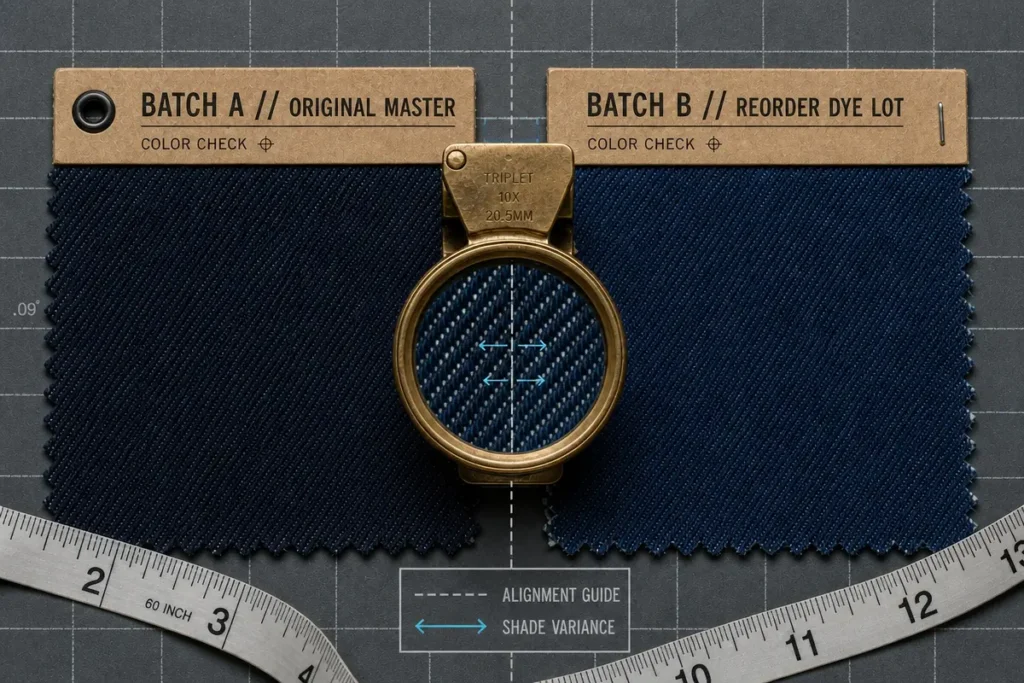
Denim production often involves natural variation. Fabric mills may supply a new dye lot, and each lot can show small differences in color, weight, or surface texture. In addition, washing can create different outcomes when fabric characteristics change.
Therefore, fabric and wash control become more important as you increase quantity.
Before a reorder, ask your supplier to confirm:
- Whether the original fabric remains available
- Whether the reorder uses the same fabric code
- Whether the new fabric lot shows a color difference
- Whether the fabric weight and composition remain consistent
- Whether the wash process requires adjustment
- Whether the factory recommends a new wash approval sample
Next, compare the new fabric swatch with your approved first-order sample. If the base color differs, the washing team may need to adjust the wash time, chemical dosage, laser settings, or abrasion process.
Moreover, keep a physical wash standard for every important style. A screen image can help communication, but it cannot fully show color depth, hand feel, fading contrast, or texture. Therefore, use an approved physical sample as the main standard whenever possible.
For more guidance on wash development, read our distressed and ripped jeans sourcing guide.
5. Decide Whether Your Reorder Needs a New Sample
A reorder does not always require full sample development. However, you should not automatically reuse the old PP sample when key materials or specifications change.
You may proceed with the existing approved sample when:
- The pattern remains unchanged
- The original fabric remains available
- The wash remains unchanged
- The hardware and trims remain unchanged
- The previous production quality met expectations
- The reorder quantity changes, but the product specification does not
On the other hand, request a new sample or confirmation sample when:
- You change fabric or fabric lot significantly
- You adjust the fit, rise, inseam, or leg opening
- You add a new wash, distressing detail, print, embroidery, or rhinestone application
- You change buttons, patches, labels, or packaging
- The first order received repeated quality complaints
- The reorder takes place after a long gap
For example, if you only increase the quantity of a proven straight-leg jean, you may only need fabric and wash confirmation. However, if you switch from rigid denim to comfort stretch denim, you need a new fit and wash review because the fabric will affect both shape and shrinkage.
As a result, you can control risk without repeating unnecessary development work.
6. Scale Quantity Without Losing Control of Cost
As order quantity increases, your unit cost can decrease. This happens because pattern development, sample work, cutting setup, wash testing, trim preparation, and quality-control preparation spread across more pieces.
However, larger quantity does not always mean the lowest total business risk. You still need to balance lower unit cost against inventory exposure.
Where that balance starts is a design choice, not a fixed rule. At Aeedenim, the minimum order quantity is 50 pcs per style, so a growth order can reuse the exact pattern, wash recipe and trim set already approved for the style instead of funding a second development cycle. For new customers the sample fee is refunded against the first bulk order, and repeat customers are not charged for samples at all — which means the development cost you carried on the original run is not paid twice when you scale up.
A practical scaling plan may look like this:
| Production Stage | Main Goal | Key Decision |
| First run | Test product-market fit | Confirm the fit, wash, and target customer |
| First reorder | Restock a proven style | Adjust size ratio and correct clear issues |
| Growth order | Improve cost efficiency | Increase quantity only for consistent sellers |
| Bulk order | Support established demand | Secure fabric, capacity, and delivery timing early |
First, use the first reorder to improve accuracy. Next, use later reorders to improve cost efficiency. Finally, move into larger bulk orders only after you understand the sales rhythm of the style.
For a detailed explanation of denim pricing factors, see our custom jeans manufacturing cost guide.
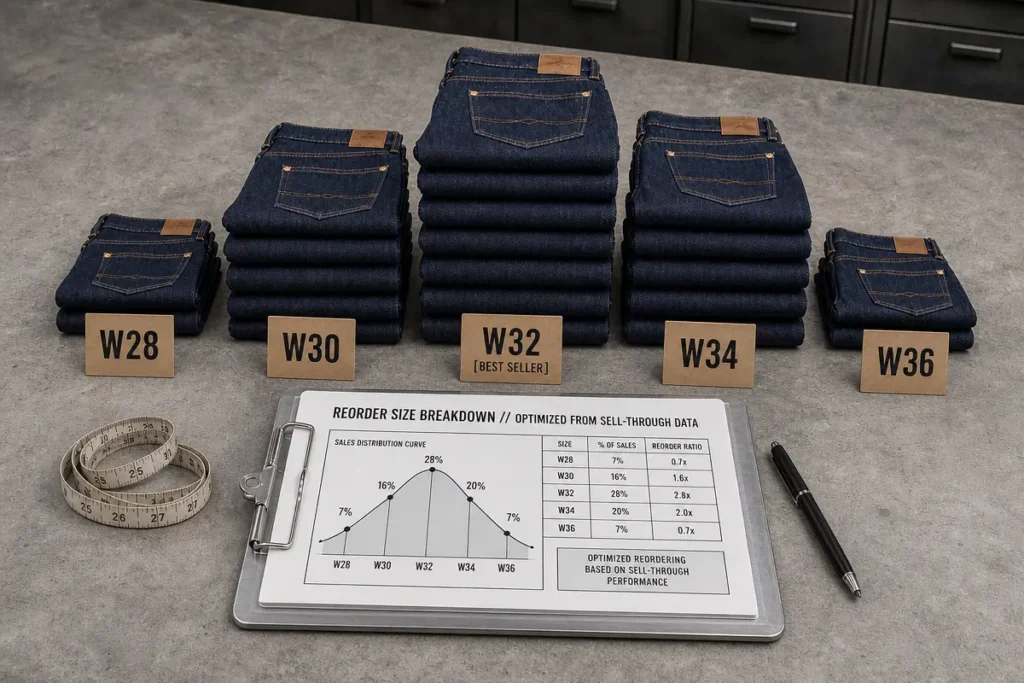
7. Plan Size Ratios Based on Sales, Not Guesswork
Many growing brands lose margin because they reorder the same size ratio every time. However, actual sales often reveal that customers buy certain sizes much faster than others.
Therefore, build your reorder size ratio from first-order data.
For example, your first order may use an even ratio across sizes 28, 30, 32, 34, and 36. After selling through the collection, you may learn that size 30 and 32 sell twice as fast as the other sizes.
In that case, your second order should increase the share of those sizes. At the same time, you can reduce the share of slower sizes without removing them completely.
Before confirming a reorder, review:
- Sales by size
- Returns by size
- Fit comments by size
- Geographic differences in size demand
- Whether the style runs large, small, or true to size
- Whether customers request additional sizes
Furthermore, separate “slow sales” from “poor size planning.” A slow-selling size may simply have received too much stock in the first order.
8. Reserve Production Capacity Before Peak Seasons
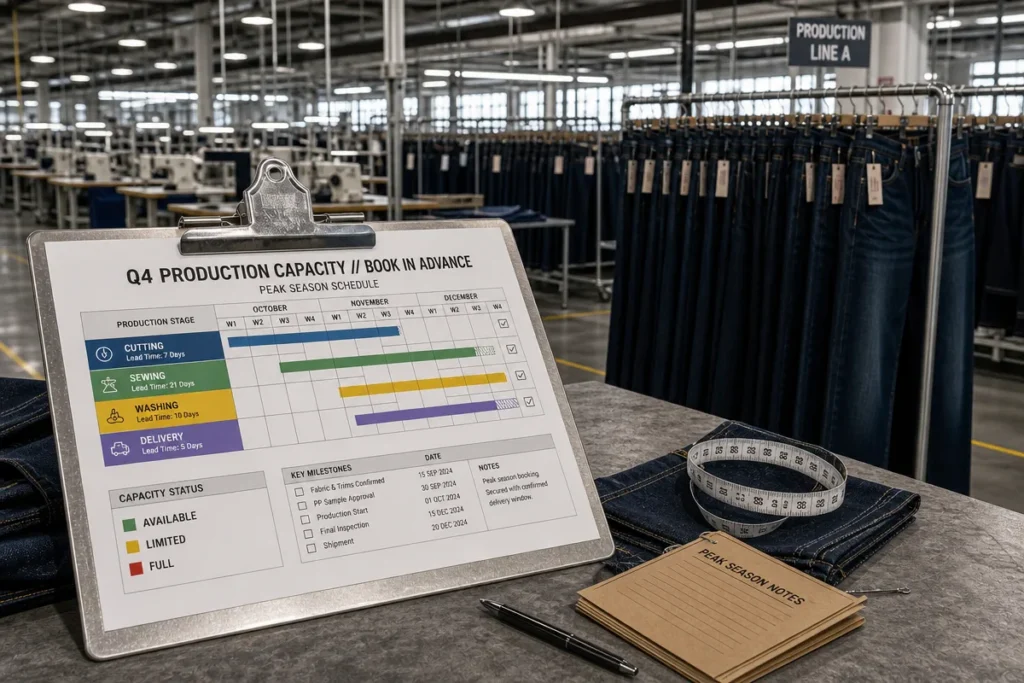
Production capacity can change during busy periods. Therefore, do not wait until stock runs out before contacting your supplier.
First, estimate when you will need the next delivery. Then, work backward from your launch date, shipping time, production schedule, fabric availability, and sample approval requirements.
For example, if you plan a holiday-season launch, confirm your fabric and production schedule early. This gives your manufacturer time to source materials, reserve washing capacity, prepare trims, and arrange quality control.
Moreover, communicate your forecast even when you do not have a final purchase order. A forecast helps your supplier understand your likely demand and identify possible material or scheduling risks in advance.
You do not need to guarantee a future quantity. However, you should share your best estimate. Clear communication helps both sides plan better.
Knowing the size of that pool makes the forecast conversation easier. Aeedenim’s lines run 30,000–50,000 units per month, and during peak season that capacity is allocated to brands that confirmed first — a forecast holds your position in the schedule without committing you to a quantity. In practice, sampling takes 7–15 days and bulk production runs about 30 days after approval, so a reorder that needs a fresh wash confirmation sample should be placed five to seven weeks before your target delivery date.
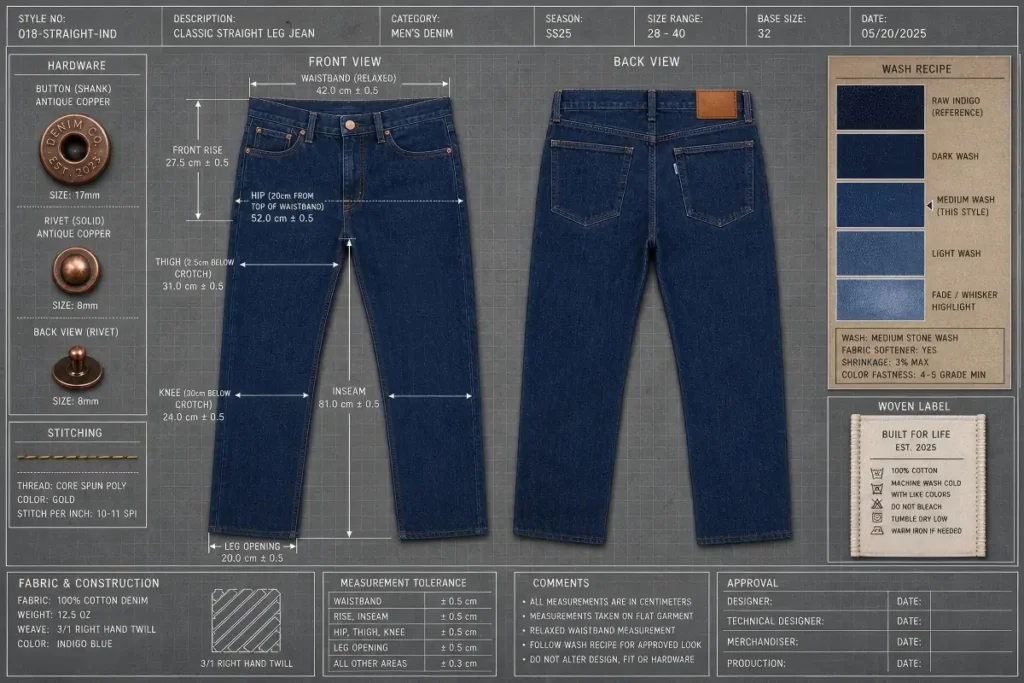
9. Build a Reorder Specification File for Every Style
A reorder specification file keeps your denim product consistent as your brand grows. It also reduces confusion when different people handle product development, purchasing, or quality control.
Your file should include:
- Style name and style code
- Product photos
- Approved PP sample photos
- Measurement chart and grading rules
- Fabric composition, weight, supplier, and fabric code
- Wash reference photos and approved physical sample notes
- Thread, stitching, hardware, patch, label, and packaging details
- Quality requirements and tolerances
- First-order production notes
- Customer feedback
- Reorder changes
- Approved revision date
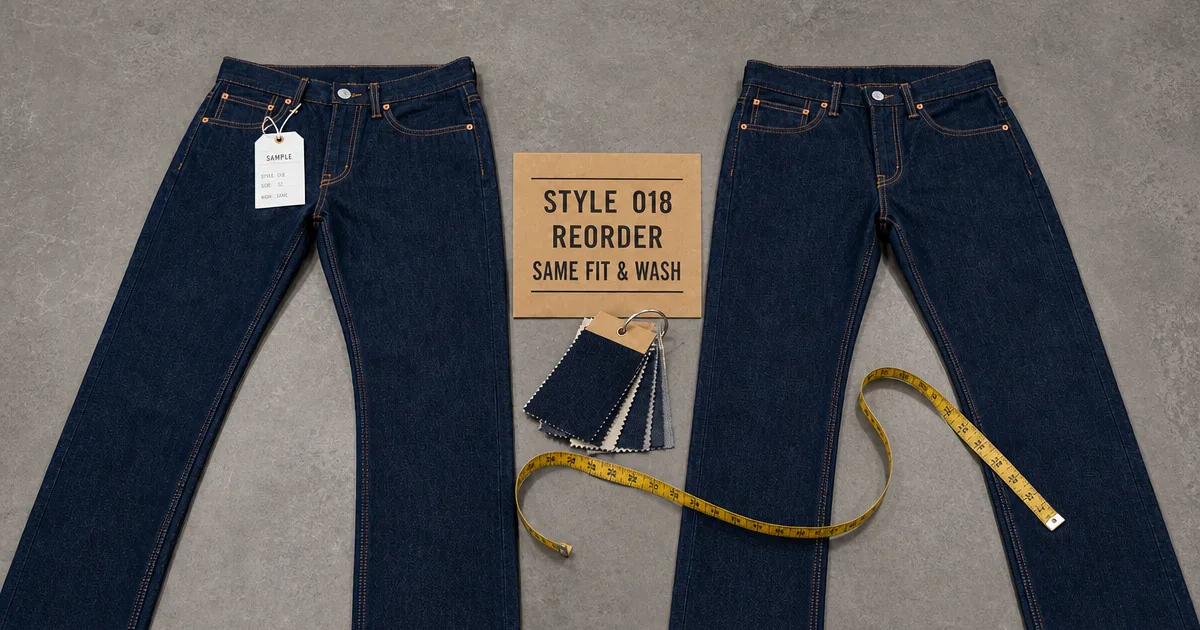
In addition, keep every updated version clearly labeled. For example, use “Style 018 Reorder Specification V2” instead of creating several unnamed files.
As a result, your team, your supplier, and your quality inspector can work from the same standard.
10. How Aeedenim Supports Denim Reorders and Production Growth
Aeedenim is a custom denim jeans manufacturer that supports brands moving from first samples to small-batch production, repeat orders and larger-volume production.
For repeat-order projects, our team can help review:
- Previous approved specifications
- Fabric availability and fabric options
- Wash references and required confirmation samples
- Updated size ratios
- New trim, label, or packaging requirements
- Target quantity and production timing
- Export packing and shipping requirements
In addition, we can help brands plan the right next step based on their product stage. For example, a new brand may need a focused small batch, while an established style may need a larger reorder with better cost efficiency.
If you are still preparing your first production run, read our small batch denim production guide and low MOQ jeans manufacturer guide.
FAQ
(1) When should I reorder custom jeans?
You should consider a reorder when the first batch sells consistently, customer feedback confirms the core fit and wash, and you understand which sizes and colors perform best.
(2) Do I need a new sample for every denim reorder?
No. You may reuse the approved PP sample when the fabric, fit, wash, trims, and quality standard remain unchanged. However, you should request a new confirmation sample when major materials or design details change.
(3) How can I keep denim wash consistency between orders?
Confirm the fabric lot, compare new fabric swatches with the approved sample, keep a physical wash standard, and approve a new wash confirmation sample when the factory recommends one.
(4) Does the unit cost decrease when I order more jeans?
Usually, yes. Larger quantities can reduce the per-unit cost because fixed development and setup costs spread across more pieces. However, you should balance lower unit cost against inventory risk.
(5) How should I plan the size ratio for a reorder?
Use first-order sales, return data, fit feedback, and restock requests. Do not repeat the original size ratio unless your sales data supports it.
(6) How early should I plan a denim reorder?
Start planning before stock runs out. Allow time for fabric confirmation, wash approval, trim preparation, production scheduling, quality inspection, and shipping.
Scale Your Next Denim Reorder With Aeedenim
Scaling custom jeans production should protect what already works while improving cost, inventory planning, and delivery control.
If you have a successful denim style ready for a reorder, contact Aeedenim with your style reference, first-order quantity, sales data, updated size ratio, target reorder quantity, and delivery timeline. Our team can help you plan the next production stage with clearer specifications and more reliable execution.