manager@aeedenim.com
How to Import Custom Jeans from China to the US and Europe: 2026 Guide

Importing custom jeans involves more than booking freight. Brands need to consider labeling, product descriptions, customs documents, HS codes, duties, shipping terms, carton marking and delivery timelines.
For startups and private label brands, preparing these details before bulk production can help reduce customs delays, unexpected costs and communication problems.
This guide explains the key points to understand when importing custom jeans from China to the US, UK and Europe.
Note: This article is for general sourcing and production planning only. Importers should always confirm final labeling, HS codes, duties, taxes and customs requirements with a licensed customs broker, freight forwarder or legal advisor.
1. Why Import Planning Should Start Before Production
Many import problems happen because brands address shipping and compliance details too late. You should confirm fiber content, care instructions, country of origin and carton marking before your factory produces labels and packaging.
Start import planning during sample development. Do not wait until your factory finishes bulk goods.
Before production, brands should confirm:
– Destination country
– Importer of record
– Shipping terms
– Product description
– Fiber composition
– Care label content
– Country of origin marking
– HS code reference
– Carton marking
– Packaging requirements
– Required customs documents
– Target delivery date
When you confirm these details early, the manufacturer can prepare labels, packing documents and shipment information more accurately.
2. US Textile Labeling Requirements
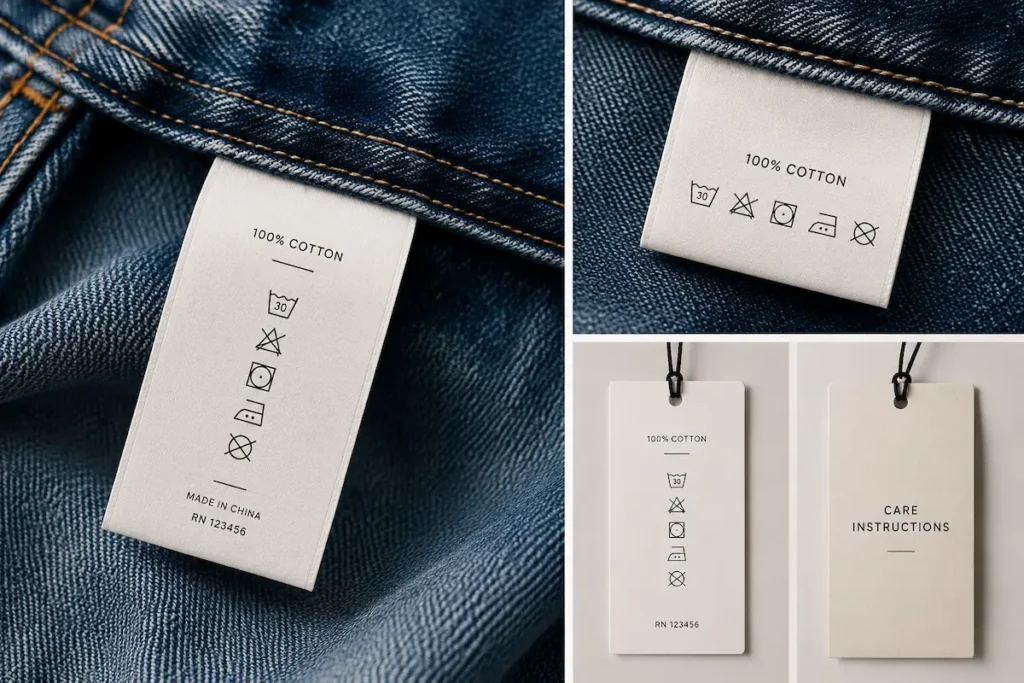
For the US market, textile apparel such as jeans, denim jackets, denim shorts and denim skirts must meet labeling requirements. These usually include fiber content, country of origin, business identification and care instructions.
A typical care label for denim jeans may include:
| Requirement | Example |
| Fiber content | 98% Cotton, 2% Elastane |
| Country of origin | Made in China |
| Responsible company / RN information | Brand name, company name or RN number where applicable |
| Care instructions | Machine wash cold, tumble dry low |
For the US market, brands should confirm with their importer, brand owner or customs broker whether the label should show a US RN number or the responsible company name.
Common mistakes to avoid include:
– Listing “denim” as a fiber name
– Forgetting fiber percentages
– Missing country of origin marking
– Using unclear care instructions
– Hiding the care label where customers cannot easily find it
– Preparing labels after bulk production has already started
“Denim” is a fabric type, not a fiber. A label should use fiber names such as cotton, polyester, elastane or other correct fiber terms.
3. EU and UK Textile Labeling Considerations
For the EU and UK markets, textile labeling requirements should also be confirmed before production. The EU requires textile products to show fiber composition using approved fiber names, and labels should generally be clear, readable and provided in the required language of the destination market.
The UK has its own requirements after Brexit, so UK shipments should be checked separately from EU shipments.
Important points to confirm include:
– Fiber composition wording
– Destination language requirements
– Care symbols or care wording
– Country of origin marking where required
– Importer or responsible party information where required
– Retailer-specific labeling requirements
– Any testing documents requested by buyers
Some retailers, marketplaces or brand buyers may request additional documents such as OEKO-TEX, test reports or chemical safety information. Specific customers or sales channels may require these, but they differ from general textile labeling rules. If your brand sells in multiple European markets, confirm label language and composition wording before bulk label production.
4. Customs Clearance: What Happens at the Border
When jeans arrive at the destination port or airport, customs reviews the shipment documents before releasing the goods. Many delays come from paperwork errors, unclear product descriptions or mismatched values.
Common import documents include:
| Document | Purpose | Usually Prepared By |
| Commercial Invoice | Declares product value, description and quantity | Manufacturer or exporter |
| Packing List | Shows carton contents, weight and dimensions | Manufacturer or exporter |
| Bill of Lading / Air Waybill | Transport document for sea or air shipment | Freight forwarder |
| Certificate of Origin | Shows where goods were manufactured, if required | Exporter or authorized organization |
| Customs Entry Documents | Used for customs clearance | Customs broker or importer |
To reduce customs risk, product descriptions should be specific. Instead of writing Clothing,use a clearer description such as:Men’s woven cotton denim jeans, 98% cotton, 2% elastane, made in China.This helps your customs broker classify the product more accurately.
5. HS Codes, Duties and Tariff Budgeting
Import duties depend on the destination country, product category, fiber composition, gender category, HS code and current trade policy.
For cotton woven jeans, common HS code references may include:
| Product Type | Common HS Code Reference |
| Men’s cotton woven trousers or jeans | 6203.42 |
| Women’s cotton woven trousers or jeans | 6204.62 |
These are reference examples only. Final classification should always be confirmed with a customs broker.
Common reference duty rates for cotton woven jeans may include:
| Destination | Common Reference Rate |
| USA | Around 16.6% for some cotton woven jeans categories |
| EU | Around 12% for some cotton trousers categories |
| UK | Around 12% for some cotton trousers categories |
Actual duty rates may change and may differ depending on product details, trade measures, fiber composition and destination country. Always confirm the final HS code and duty rate before shipment.
A simple duty calculation may look like this:Duty = Declared Customs Value x Duty Rate
For example, if a shipment has a declared customs value of USD 15,000 and the reference duty rate is 16.6%, the estimated duty would be:USD 15,000 x 16.6% = USD 2,490
This does not include broker fees, port charges, taxes, local delivery or other possible import costs.
Need a specific duty estimation for your destination? Click here to consult our shipping specialist on WhatsApp for free expert advice.
6. Shipping Options: Air Freight vs. Sea Freight
The best shipping method depends on order quantity, budget and delivery timeline.
| Factor | Air Freight | Sea Freight |
| Transit time | Faster | Slower |
| Cost per unit | Higher | Lower for bulk orders |
| Best for | Samples, rush orders, small drops | Bulk production orders |
| Charging method | Usually by weight or volume weight | LCL or FCL shipment |
| Documentation | Required | Required |
Air freight may be suitable for samples, urgent launches or smaller test orders. Sea freight is usually more cost-effective for larger bulk orders.
As a general planning reference:
- Air freight may take around 5-10 days after departure, depending on route and customs.
- Sea freight may take several weeks depending on destination port, vessel schedule and customs clearance.
Brands should also consider inland delivery time after customs release.
7. FOB vs. DDP: Understanding Shipping Terms
Two common shipping terms for denim imports are FOB and DDP.
| Term | Meaning | Who Usually Handles Main Freight and Customs | Best For |
| FOB | Seller delivers goods to the port of shipment | Buyer or buyer’s forwarder | Experienced importers |
| DDP | Seller or arranged forwarder handles delivery to destination including customs process | Seller-side forwarder or service provider | First-time importers or brands without a broker |
FOB gives buyers more control over shipping and customs, especially if they already have a freight forwarder or customs broker.
DDP can simplify the delivery process for first-time importers, but brands should still confirm exactly what is included in the quote, such as:
- International freight
- Duties
- Taxes
- Customs clearance
- Local delivery
- Remote-area charges
- Insurance
- Delivery address limitations
DDP is convenient, but it should be clearly written in the quotation or purchase order.
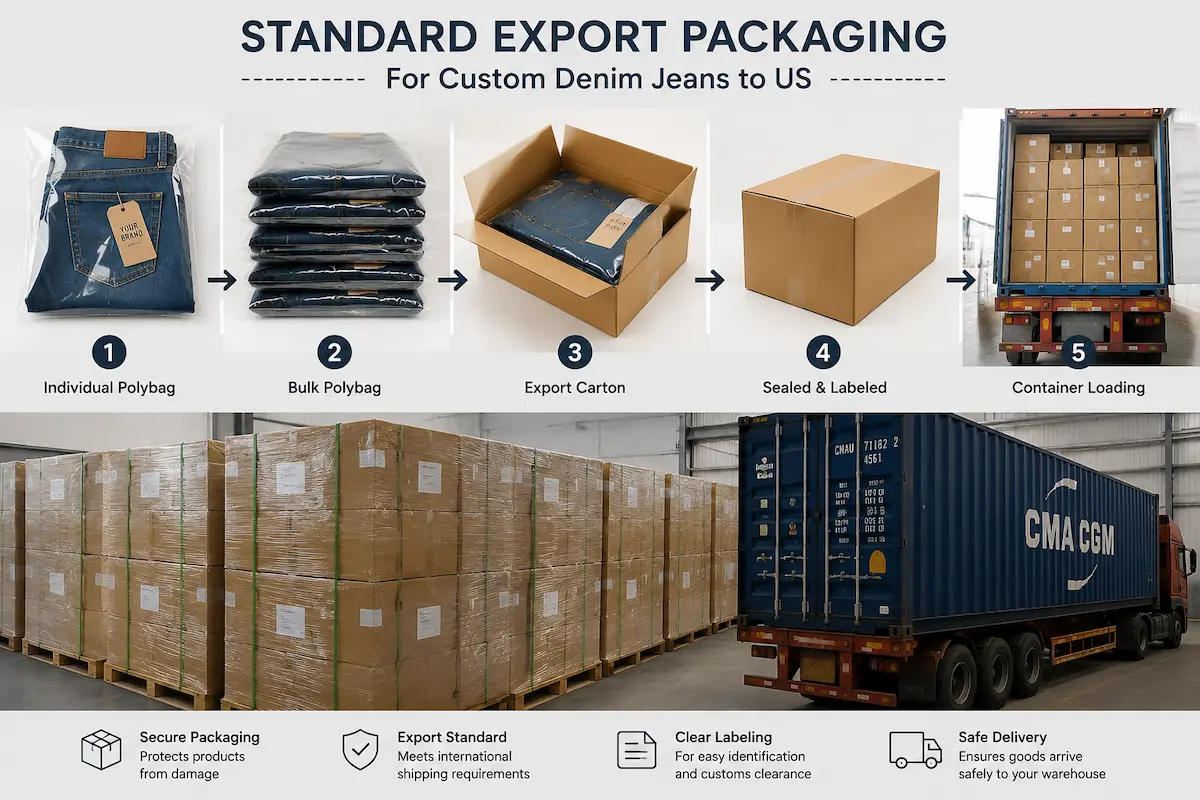
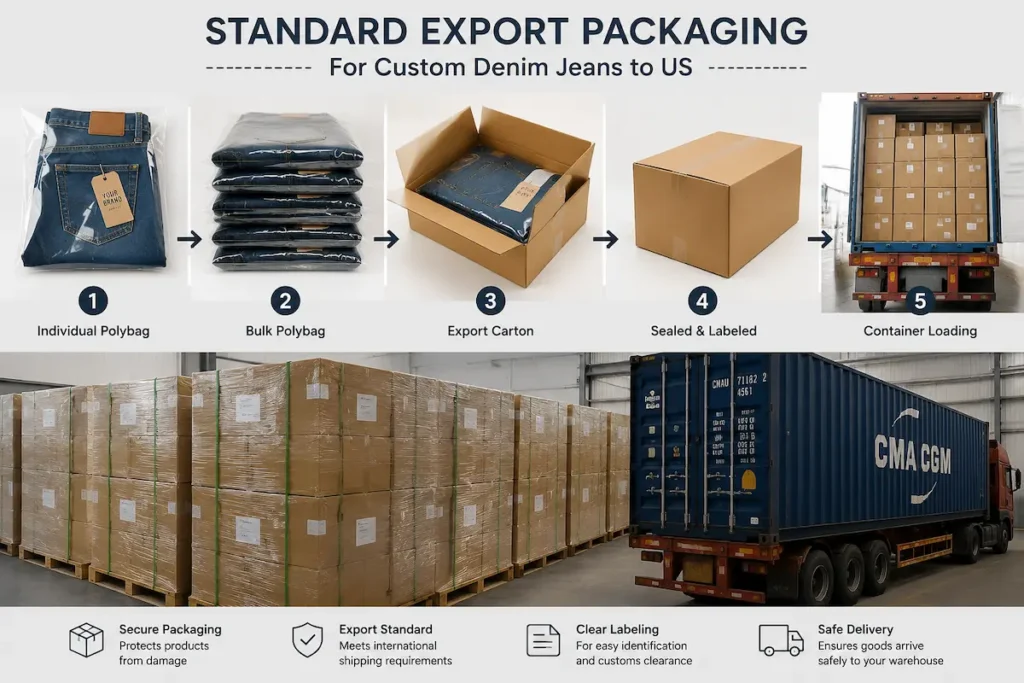
8. Packaging and Carton Marking for Export
International shipping requires clear carton marking and protective packaging. This helps warehouses, forwarders and customs teams identify the goods correctly.
Common carton marking may include:
- Buyer reference
- Style number
- Carton number
- Quantity per carton
- Gross weight
- Net weight
- Carton dimensions
- Country of origin marking
- Destination information
- Handling instructions such as “Keep Dry”
For denim products, standard export packaging may include:
- Individual poly bags
- Size or SKU stickers
- Reinforced cartons
- Moisture protection for sea shipments
- Extra wrapping for embellished styles
- Retailer-specific barcode labels if required
If your jeans include rhinestones, embroidery, patches or special washes, additional protection may be needed to reduce friction damage during transit.
9. What Buyers Should Confirm with Their Customs Broker
Before bulk production or shipment, buyers should confirm key import details with their customs broker or freight forwarder.
Important questions include:
- What is the correct HS code?
- What is the current duty rate?
- Are there additional tariffs or trade measures?
- Who is the importer of record?
- What labeling is required for the destination country?
- Is country of origin marking required on the garment, packaging or both?
- Are VAT, GST or import taxes payable?
- What documents are required for customs clearance?
- Is a certificate of origin needed?
- What should the product description say on the invoice?
- What is included in a DDP quote?
- Are there any retailer-specific requirements?
Getting these answers early helps the factory prepare labels, packing information and documents correctly.
10. Pre-Production Checklist for US, UK and EU Imports
Before your manufacturer starts bulk production, confirm the following:
- Destination country confirmed
- Importer of record confirmed
- Shipping terms confirmed in writing
- Care label content approved
- Fiber composition confirmed
- Country of origin wording confirmed
- HS code reference checked with broker
- Product description prepared
- Carton marking requirements shared
- Packaging requirements confirmed
- Commercial invoice details reviewed
- Packing list format confirmed
- Duty and tax budget estimated
- Target delivery timeline confirmed
A professional denim manufacturer should be able to coordinate with the buyer and freight forwarder to prepare shipment documents and packing details before delivery.
11. How Aeedenim Supports Denim Export Preparation
Aeedenim is a custom denim manufacturer in China working with fashion startups, streetwear brands, independent designers and private label collections.
For international orders, we can support export preparation by:
- Preparing commercial invoices and packing lists
- Supporting care label preparation based on buyer-provided requirements
- Coordinating carton marking and packing details
- Helping prepare product descriptions for shipping documents
- Coordinating with freight forwarders for FOB or DDP shipment options
- Supporting packaging protection for embellished or washed denim products
- Helping brands plan shipping timelines before bulk production
- Communicating with buyers and forwarders before shipment
Aeedenim helps brands connect production, packaging and shipment planning so custom denim products can move from factory to destination more smoothly.
12. FAQS
(1) What labeling is required to import jeans to the US?
US textile apparel usually needs labels showing fiber content, country of origin, business identification or RN information where applicable, and care instructions. Brands should confirm final label content with their importer, customs broker or legal advisor.
(2) Do EU and UK labeling requirements differ from the US?
Yes. EU and UK textile labeling requirements may differ from US requirements, especially in fiber naming, label language and market-specific information. The UK should be checked separately from the EU.
(3) How much are import duties on jeans from China?
Duty rates depend on destination country, HS code, fiber composition and current trade policy. Some cotton woven jeans categories may have reference rates around 16.6% for the US and around 12% for some EU or UK categories, but final rates must be confirmed with a customs broker.
(4) What is the difference between FOB and DDP?
With FOB, the buyer usually arranges main freight, customs clearance and local delivery after the goods are delivered to the port of shipment. With DDP, the seller-side forwarder may handle delivery to the destination including customs process and duties, depending on the quote details.
(5) How long does shipping take from China to the US or Europe?
Air freight may take around 5-10 days after departure, while sea freight usually takes several weeks depending on destination port, vessel schedule and customs clearance. Inland delivery time should also be considered.
(6) What documents do I need to clear customs?
Common documents include a commercial invoice, packing list, bill of lading or air waybill, and sometimes a certificate of origin. Your customs broker can confirm the exact documents needed for your shipment.
(7) Can Aeedenim help with shipping and customs preparation?
Aeedenim can help prepare export documents, coordinate with freight forwarders and support packing, carton marking and label preparation based on buyer-provided requirements. Buyers should still confirm final customs and legal requirements with their broker or advisor.
Know your import costs. Read our transparent pricing breakdown for custom jeans manufacturing, from fabric to landed cost for US/EU brands.
Start Your Custom Denim Import Plan
Importing custom jeans from China to the US, UK or Europe becomes easier when production, labeling, packaging and shipping details are planned early.
Contact Aeedenim to discuss your custom denim project, labeling requirements, shipping terms and delivery timeline. Our team can help prepare your order for sampling, bulk production and export shipment.