
 manager@aeedenim.com
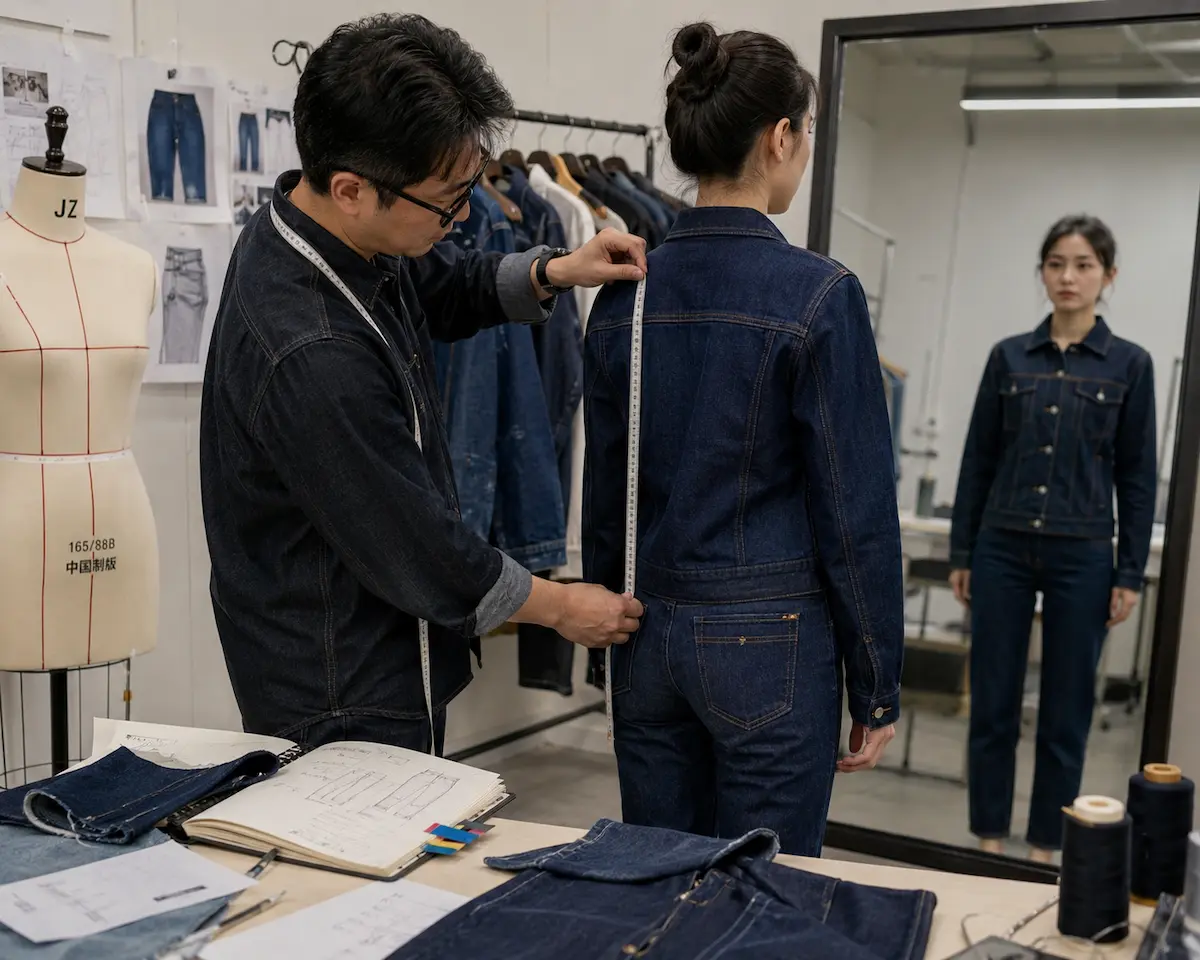
How to Develop the Perfect Jeans Fit: Silhouettes, Size Grading and Sampling Guide

A great denim fabric means very little if the fit is wrong. For fashion brands, streetwear labels and private denim collections, fit can be the difference between a successful launch and a product that customers do not reorder.
Unlike basic T-shirts, jeans require careful pattern development, size grading, fabric shrinkage control and sample fitting. A small error in waist, hip, rise or leg opening can affect the entire size range and lead to inconsistent bulk production.
This guide explains how brands can work with a custom denim manufacturer to develop market-ready jeans fits, from silhouette selection to size grading, sampling and final production control.
1. Why Jeans Fit Development Matters
Fit is one of the most important parts of custom jeans production. Even if the fabric, wash and trims look good, customers will not keep wearing the product if the fit feels uncomfortable or inconsistent.
Good fit development helps brands:
– Build a clear product identity
– Reduce return risk
– Improve customer satisfaction
– Keep size consistency across bulk production
– Create repeatable best-selling styles
– Launch new silhouettes with more confidence
For denim, fit development should begin before bulk fabric cutting. The earlier pattern and grading issues are found, the easier they are to correct.
2. Understanding US and EU Fit Preferences
Different markets may have different expectations for jeans fit, although these preferences are not fixed rules. A brand’s target customer, gender category, price positioning and style direction all matter.
Many US streetwear and casual brands may prefer relaxed, straight, bootcut or roomier fits with more comfort in the hip and thigh. Many European fashion collections may focus on slimmer, cleaner or cropped silhouettes. However, baggy jeans, wide-leg jeans and Y2K-inspired fits are also popular across both markets.
A custom jeans manufacturer should help brands review the target market before developing the base pattern.
Below is a general reference for different market directions:
| Market Direction | Common Fit Preference | Example Silhouettes |
| US casual and streetwear | Roomier,relaxed,comfort-focused | Straight leg, relaxed taper, bootcut, baggy |
| EU fashion collections | Cleaner, slimmer or more tailored | Slim straight, skinny, cropped flare, slim taper |
| UK casual fashion | Balanced fit with practical comfort | Regular straight, slim taper, relaxed straight |
| Minimalist or Scandinavian style | Clean lines and simple proportions | Straight leg, wide leg, boxy fits |
These are only reference points. The final fit should always match your brand’s customer and design direction.
3. Essential Jeans Silhouettes for a Denim Collection
Most denim brands build their collection around a few core silhouettes. Each fit requires different pattern decisions and fabric choices.
(1) Straight Leg Jeans
Straight leg jeans are one of the most versatile denim silhouettes. They sit naturally from hip to hem with a consistent leg shape.
They work well for:
– Men’s jeans
– Women’s jeans
– Classic denim collections
– Washed jeans
– Everyday casual styles
Straight leg jeans can be adjusted with low rise, mid rise or high rise depending on the target market.
(2) Slim Taper Jeans
Slim taper jeans are fitted through the hip and thigh, then narrow from the knee to the ankle. This fit is common in premium casualwear and modern menswear.
For slim taper jeans, grading must be handled carefully so the taper ratio remains balanced across different sizes.
(3) Wide Leg and Relaxed Jeans
Wide leg and relaxed jeans are popular in streetwear, Y2K-inspired collections and comfort-focused fashion. They provide more volume and are often developed with rigid or heavyweight denim for better structure.
Key pattern points include:
– Crotch shape
– Thigh width
– Knee width
– Leg opening
– Fabric weight
– Overall balance from waist to hem
If the pattern is not balanced, the jeans may look oversized rather than intentionally relaxed.
(4) Skinny Jeans
Skinny jeans are body-hugging from waist to ankle. They usually require stretch denim because the garment must move with the body.
For skinny jeans, the pattern needs to account for fabric stretch, recovery and comfort. Washing must also be controlled carefully to protect the elastic fibers.
(5) Bootcut and Flare Jeans
Bootcut and flare jeans are fitted through the thigh and open from the knee to the hem. These silhouettes are often used in women’s fashion, Western-inspired collections and Y2K denim lines.The flare shape should remain consistent across the full size range. Even small changes in knee width or leg opening can change the final look.
Fit is where a style is won or lost – see how our lift-up jegging denim jeans carry a sculpting stretch construction from pattern to production.
4. What Is Size Grading in Jeans Production?
Size grading is the process of scaling a base pattern up and down to create a full size range. For example, a men’s jeans collection may use size 32 as the base size, while a women’s collection may use size 27 or 28.
The goal of grading is not just to make each size bigger or smaller. The goal is to maintain the same fit balance, silhouette and proportion across the full size range.
Common jeans grading points include:
| Measurement Point | Common Consideration |
| Waist | Must match the target fit and waistband structure |
| Hip | Affects comfort, seat shape and overall fit |
| Inseam | Depends on market, gender category and style |
| Front Rise | Affects crotch comfort and waistband position |
| Back Rise | Affects seat coverage and back waist fit |
| Thigh | Important for relaxed, slim and skinny fits |
| Knee | Controls taper, flare and leg balance |
| Leg Opening | Defines straight, tapered, bootcut or flare shape |
Actual grading rules should be adjusted based on fabric stretch, shrinkage, gender category, target market and brand fit standard.
5. Why Jeans Grading Goes Wrong
Size grading can go wrong when a factory applies simple formulas without understanding the fit.
Common reasons include:
– Using the wrong base size
– Applying the same grading rule to every silhouette
– Ignoring fabric stretch and shrinkage
– Treating hip and waist growth the same way
– Not checking knee and leg opening proportions
– Skipping size set samples
– Not testing the final wash before bulk production
For example, stretch denim, rigid denim and heavyweight denim may all need different pattern adjustments. A slim taper fit and a wide leg fit should not be graded in exactly the same way.
A reliable denim factory should have experienced pattern makers who understand both measurement rules and real garment fit.
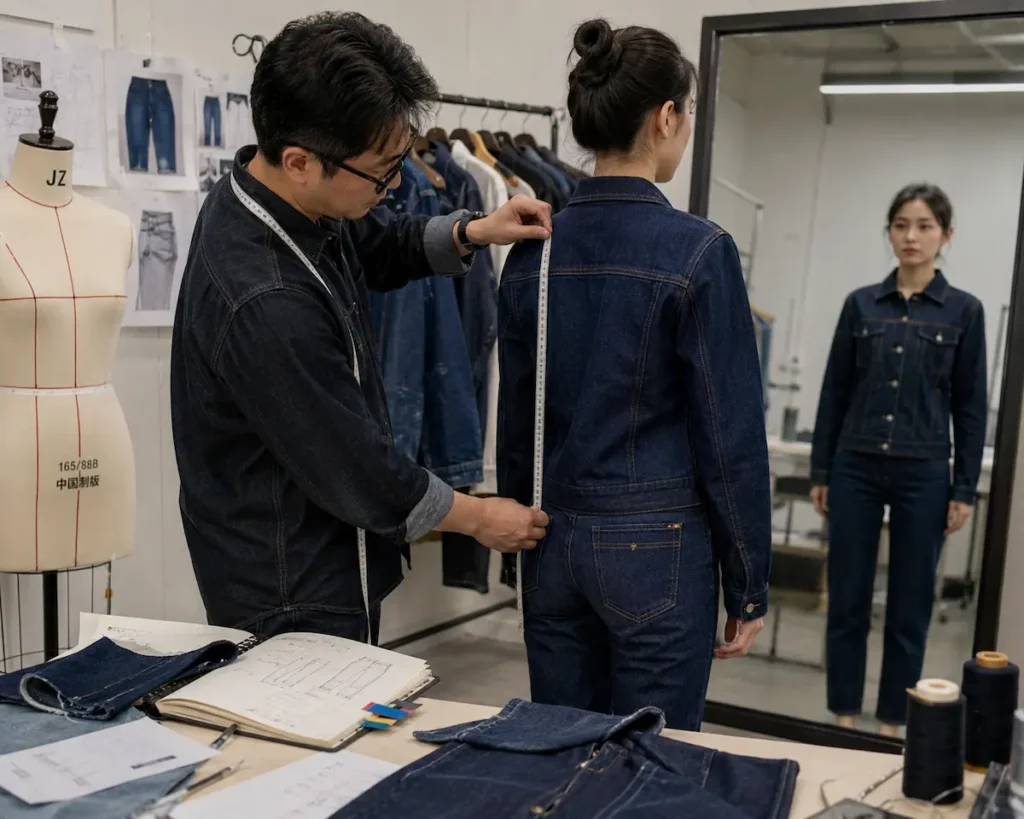
6. The Sample Fitting Process
Before bulk production, custom jeans usually need multiple sampling stages. The number of rounds depends on the complexity of the design, fabric, wash and fit requirements.
(1) Round 1: Proto Sample or Fit Sample
The proto sample is usually made in the base size only. Its purpose is to check the overall silhouette, proportion and construction.
At this stage, the sample may not need final wash or final trims. The main focus is fit.
You should check:
– Waist position
– Hip comfort
– Rise
– Thigh width
– Knee position
– Leg opening
– Overall silhouette
– Pocket placement
(2) Round 2: Size Set Sample
A size set sample checks whether the grading works across multiple sizes. This is especially important for brands selling across a wide size range.
A common size set may include 3-5 key sizes, such as:28 / 30 / 32 / 34 / 36,or for women’s jeans:24 / 26 / 28 / 30 / 32.
The goal is to confirm that the jeans keep the same fit logic across sizes.
(3) Round 3: Pre-Production Sample
The pre-production sample, often called a PP sample, should use the confirmed fabric, final wash, final trims and approved construction details.
This sample represents what will be produced in bulk. It should be approved before fabric cutting and mass production begin.
7. Why Fit Development Helps Reduce Return Rates
Poor fit is one of the main reasons customers return jeans. Unlike oversized tops, jeans need to work closely with the body’s waist, hip, rise, thigh and leg shape.
Fit issues can lead to:
– Waist too tight or too loose
– Back waist gap
– Crotch discomfort
– Excess fabric around the thigh
– Knee bagging
– Inconsistent inseam length
– Unbalanced flare or taper
– Wrong shrinkage after wash
For online fashion brands, these problems can increase return rates and hurt customer trust. Proper sample fitting and size grading help reduce these risks before bulk production.
A good fit development process is not just a technical step. It is also a way to protect your brand reputation.
8. Common Jeans Fit Issues and Possible Fixes
During sample review, brands and manufacturers should check common fit issues carefully.
Troubleshooting Common Fit Issues:
| Fit Issue | Possible Cause | Possible Adjustment |
| Waist too tight but hip fits well | Waist-to-hip balance is off | Adjust waist measurement separately from hip |
| Back waist gap | Back rise or hip curve may be insufficient | Adjust back rise and waistband curve |
| Horizontal crotch lines | Front rise may be too short or crotch curve too tight | Review front rise and crotch shape |
| Excess fabric at crotch | Crotch depth or thigh balance may be too large | Adjust crotch curve and thigh width |
| Knee bagging | Fabric recovery or knee width may not match the fit | Review fabric choice and knee measurement |
| Twisted side seam | Fabric torque or pattern alignment issue | Check fabric direction and pattern placement |
| Flare shape inconsistent | Knee and leg opening grading not balanced | Adjust flare grading across sizes |
These are general references. The final adjustment should be based on physical samples, fabric behavior and the target fit.
9. Tech Pack Requirements for Fit Development
A complete tech pack makes fit development faster and more accurate. If possible, prepare the following information before contacting a manufacturer:
– Front and back flat sketches
– Reference photos
– Base size measurement table
– Full size spec if available
– Target size range
– Fabric weight and composition
– Stretch percentage if using stretch denim
– Shrinkage information if available
– Wash reference
– Trim details
– Pocket placement
– Tolerance table
– Fit comments from previous samples
If you do not have a complete tech pack, a custom jeans manufacturer can help develop a base pattern from reference photos, target measurements or an existing sample.
10. How Aeedenim Supports Jeans Fit Development
Aeedenim supports fashion startups, streetwear brands, independent designers and private labels with custom denim development, including jeans, denim jackets, shorts, skirts and denim sets.
For jeans fit development, we can help with:
– Base pattern development from tech packs or reference images
– Silhouette review for different markets
– Men’s and women’s size range development
– Proto sample development
– Size set sample support
– Pre-production sample development
– Fit adjustment based on sample feedback
– Fabric shrinkage review
– Wash and measurement coordination
– Low MOQ production depending on design and fabric requirements
Our team helps brands review fit details before bulk production, reducing the risk of inconsistent sizing and improving the development process.
Great fit deserves great branding. Read our guide on private label denim branding to learn how custom buttons, patches and packaging complete your denim collection.
11.FAQ
(1) What is size grading?
Size grading is the process of scaling a base pattern up and down to create a full size range while keeping the same fit balance and silhouette.
(2) How many samples do I need before bulk production?
Most jeans projects need 2-3 rounds of samples: a fit sample, a size set sample and a pre-production sample. The exact number depends on design complexity, fabric, wash and fit requirements.
(3) Why is US fit different from EU fit?
US and EU fit preferences can differ because of customer habits, brand positioning and style direction. US casual and streetwear brands may prefer more relaxed fits, while some European fashion collections may prefer slimmer or cleaner silhouettes. However, the final fit should always match the brand’s target customer.
(4) What measurements should I provide for custom jeans?
Important measurements include waist, hip, front rise, back rise, inseam, thigh, knee and leg opening. If possible, provide a full size spec table and reference sample.
(5) How long does fit development take?
A proto sample may take around 7-15 days after details are confirmed. A complete fit development process with several sample rounds may take 3-5 weeks depending on complexity.
(6) Can Aeedenim develop a jeans fit from photos?
Yes. Aeedenim can help develop a base pattern from reference photos and target measurements. However, a physical reference sample or detailed spec sheet can improve accuracy.
(7) Does fabric affect jeans fit?
Yes. Fabric weight, stretch, shrinkage and recovery all affect fit. Stretch denim, rigid denim and heavyweight denim may require different pattern and grading adjustments.
Start Your Jeans Fit Development.
Looking for a custom denim manufacturer that understands jeans fit, size grading and sample development?
Contact Aeedenim to discuss your silhouette, target market, size range, fabric choice and sampling requirements. Our team can help turn your jeans concept into a production-ready denim product.